
A tiny kitten without history can still reveal its age through simple physical clues. When a kitten appears with no record, understanding its age becomes essential for feeding, vaccination timing, and safe care decisions.
Growth patterns in early life follow a predictable timeline, making it possible to estimate age using a few visible signs.
Eyes, ears, teeth, weight, and mobility together provide a reliable window into development from the newborn stage through several weeks.
No single indicator is enough, but combining them gives surprisingly accurate results even without veterinary tools or medical records.
Today, we explain how to read those signs clearly so that kitten-care decisions can be made with confidence, and common mistakes new caretakers often make early on can be avoided.
Why Knowing Your Kitten’s Real Age Actually Matters
Age is not trivia; it is the foundation for nearly every care decision ahead. A newborn under two weeks old needs round-the-clock bottle feeding and cannot yet regulate its own body temperature.
A four-week-old is starting to try solid food. An eight-week-old is often old enough for first vaccines and, in many clinics, early spay or neuter surgery.
Get the age wrong, and you risk overfeeding a fragile newborn’s stomach or delaying care a growing kitten genuinely needs.
Shelters and veterinary clinics lean on the same physical checkpoints laid out in widely used general kitten care guidance.
Once you have even a rough idea of its age, caring for a new kitten stops feeling like guesswork and starts feeling like a routine you can actually follow.
How to Tell a Kitten’s Age by Early Physical Signs
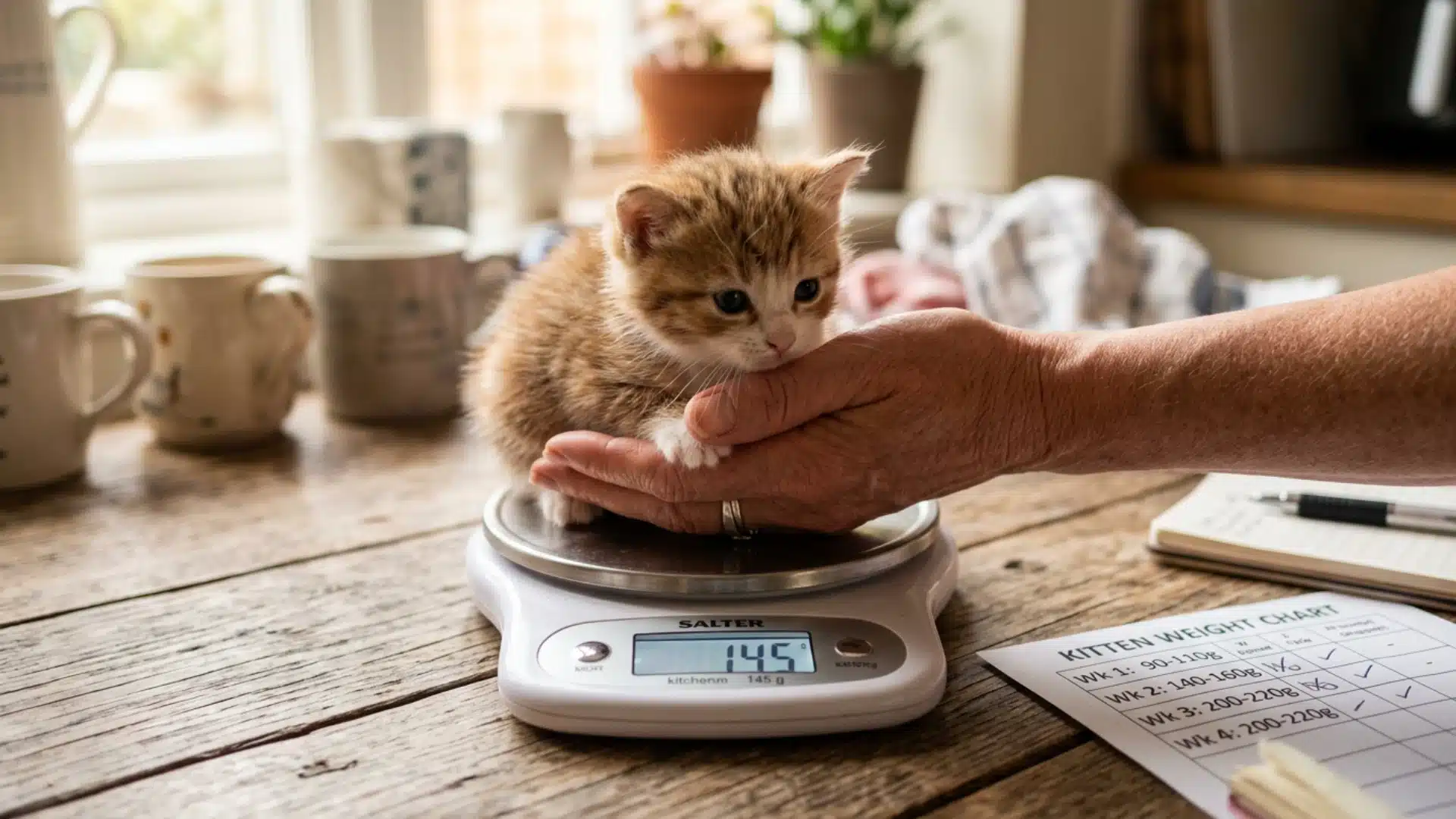
Early physical changes can quickly reveal a kitten’s age. Look at body size, eye development, ear position, movement, and overall coordination to narrow down the kitten’s stage in the first weeks.
1. Check Weight Before Anything Else
Weight is the quickest first clue when estimating a kitten’s age. It is simple and fast, and it does not require checking the mouth or waiting to see how the kitten moves.
Young kittens usually gain weight at a steady pace during the first few weeks.
A common rescue guideline is about 1 pound of weight gain per month for the first 4 months.
Weight can be misleading. A malnourished six-week-old kitten may weigh the same as a healthy four-week-old.
Use weight as one clue, not the final answer. Cross-check it with teeth, eyes, ears, or movement. Once you estimate the age, compare it with a kitten age chart and vaccine schedule.
If the kitten seems too thin or too heavy for its age, schedule a vet check.
2. Kitten Eye Changes by Age
A kitten’s eyes can give an early clue about age, especially during the first few weeks.
Newborn kittens are born with their eyes fully sealed, and they usually stay closed for about seven to ten days.
Once the eyes begin to open, they may look cloudy, bluish-grey, and slightly sensitive to light.
- Birth to 7 days: Eyes remain closed and sealed.
- 7 to 10 days: Eyes usually begin to open slowly.
- Newly opened eyes: They often appear cloudy and bluish-grey, and may squint in bright light.
- 5 to 7 weeks: The haze begins to clear, and adult eye color starts showing.
- Up to 3 months: Eye color may still change slightly.
3. When Kitten Ears Start to Stand Up
A kitten’s ears can also help estimate age, especially when checked with eye development and movement.
Newborn kittens have ears folded flat against the head, making them look small and tucked in.
- Birth: Ears are folded flat against the head.
- Week 2: Ears start to unfold and lift slightly.
- Weeks 2 to 3: Hearing begins to develop as ears open more.
- Weeks 3 to 4: Ears usually stand fully upright.
- 3 to 4 weeks: Open eyes, upright ears, and clumsy movement suggest this age.
This timeline is most useful for kittens under one month old overall.
4. Using Teeth as an Age Clock
Teeth are among the most reliable ways to narrow down age, since eruption follows a near-fixed order laid out in feline tooth eruption timelines that most vets rely on in exam rooms.
- Toothless (birth to 2 weeks): No visible teeth yet; gums are smooth and pink.
- Baby incisors emerge (2 to 3 weeks): Tiny front teeth poke through first.
- Canines and premolars appear (3 to 6 weeks): Pointed teeth and side chewing teeth fill in next.
- Full baby set complete (6 to 8 weeks): All 26 deciduous teeth are typically in place.
- Adult teeth replace baby teeth (3 to 6 months): Baby teeth fall out as 30 permanent teeth grow in behind them.
For a deeper breakdown of what falls out when, the kitten teething timeline covers each stage in detail.
5. Mobility and Coordination Clues
How a kitten moves is one of the more fun signs to check, mostly because the transformation happens so fast.
A kitten that cannot lift its own head is a very different animal from one sprinting across a room two weeks later.
- 0-2 weeks: Mostly immobile, with weak crawling using front legs to drag toward mom or a heat source.
- 2-3 weeks: Wobbly, uncoordinated walking begins. Expect a lot of face-plants.
- 3-4 weeks: Walking becomes steadier, and short bursts of play appear.
- 5-6 weeks: Running, pouncing, and climbing kick in, often all at once and often at 3 a.m.
- 8-10 weeks: Full coordination, confident jumping, and the kind of reckless energy that knocks things off tables.
For general feeding and handling guidance once a kitten hits this stage, our kitten care basics guide is a good next stop.
6. Behavior and Social Signs that Reveal Age
Physical development tells part of the story, but behavior fills in the rest, especially once a kitten starts interacting with its environment instead of just existing in it.
- Nursing only, no interest in solid food: Usually under 3 weeks.
- Sniffing at wet food, messy attempts to eat it: Around 3-4 weeks, the start of weaning.
- Using a litter box with some consistency: Typically 4 weeks and up.
- Play-fighting with littermates, stalking toys: 5-6 weeks, once coordination catches up to curiosity.
- Fully weaned, eating solid food independently: 6-8 weeks, per general care guidance from the ASPCA.
A kitten that is already confidently using a litter box and eating on its own is not a newborn, no matter how small it looks.
When to Ask a Vet to Confirm the Age

Physical signs can help you estimate a kitten’s age. Still, a vet exam is the safest way to confirm it, especially if the kitten looks unusually small, weak, or develops differently than expected.
Accurate age matters because feeding amounts, bottle-feeding schedules, vaccine timing, and general care all depend on it.
Call a vet instead of guessing if:
- The kitten’s signs do not match one clear age range on the chart.
- Some traits make the kitten seem younger, while others suggest it is older.
- The kitten looks too thin, small, weak, or inactive for its expected age.
- Its eyes have not opened, it is not walking, or it shows no interest in food by the expected time.
- You plan to bottle-feed, since the amount and frequency must match the kitten’s age.
If you’re unsure of a kitten’s age or it appears weak, underweight, dehydrated, or is having trouble feeding, seek veterinary care as soon as possible. A veterinarian can accurately assess its age, check for underlying health problems, and recommend the appropriate feeding and care plan.
Conclusion
Estimating a kitten’s age is less about finding one perfect number and more about getting close enough to make safe care choices today.
Weight, eyes, ears, teeth, and behavior may not all point to the same week, especially if the kitten is small, hungry, or developing at a slightly different pace.
That is normal. When checked together, these clues usually narrow the age to a one- or two-week range, which helps with feeding, vet visits, vaccines, and daily handling.
Trust the overall pattern rather than a single sign. If the clues feel confusing or the kitten seems weak, call a vet. Found a kitten recently?
Share its signs in the comments and help others compare notes with confidence too.
Frequently Asked Questions
Can I Estimate a Kitten’s Age from Its Teeth Alone?
Teeth can help, but they are not exact. Eruption timing varies slightly, so compare teeth with weight, eye clarity, and movement for a better estimate.
Why Do Vets Give an Age Range Instead of an Exact Number?
Kittens develop at slightly different speeds, even in the same litter. A range is more accurate unless the exact birth date is known.
What if My Rescued Kitten Seems Smaller than the Chart Suggests?
Small size does not always mean younger. Poor nutrition, illness, or a rough start can affect growth, so check other signs too.
Does a Bottle-Fed Kitten Age Differently from a Weaned One?
No. The growth timeline stays the same. Bottle-fed kittens need more frequent feeding and hands-on care, especially under 4 weeks old.