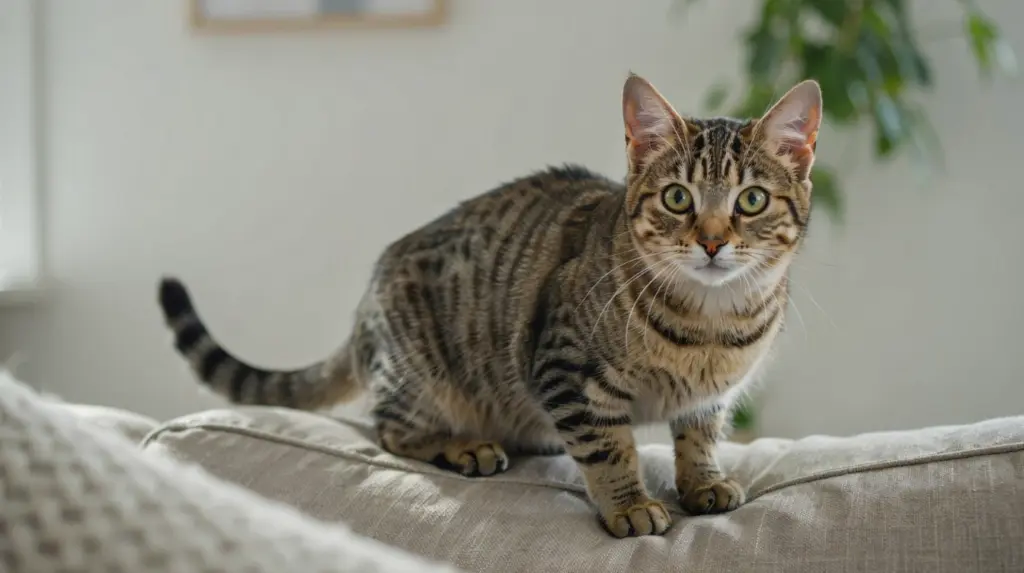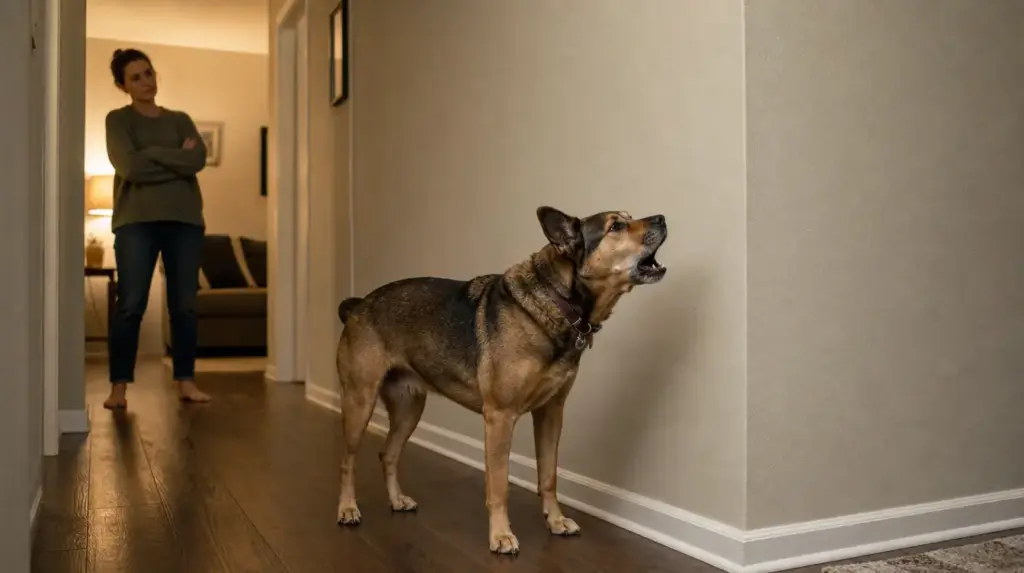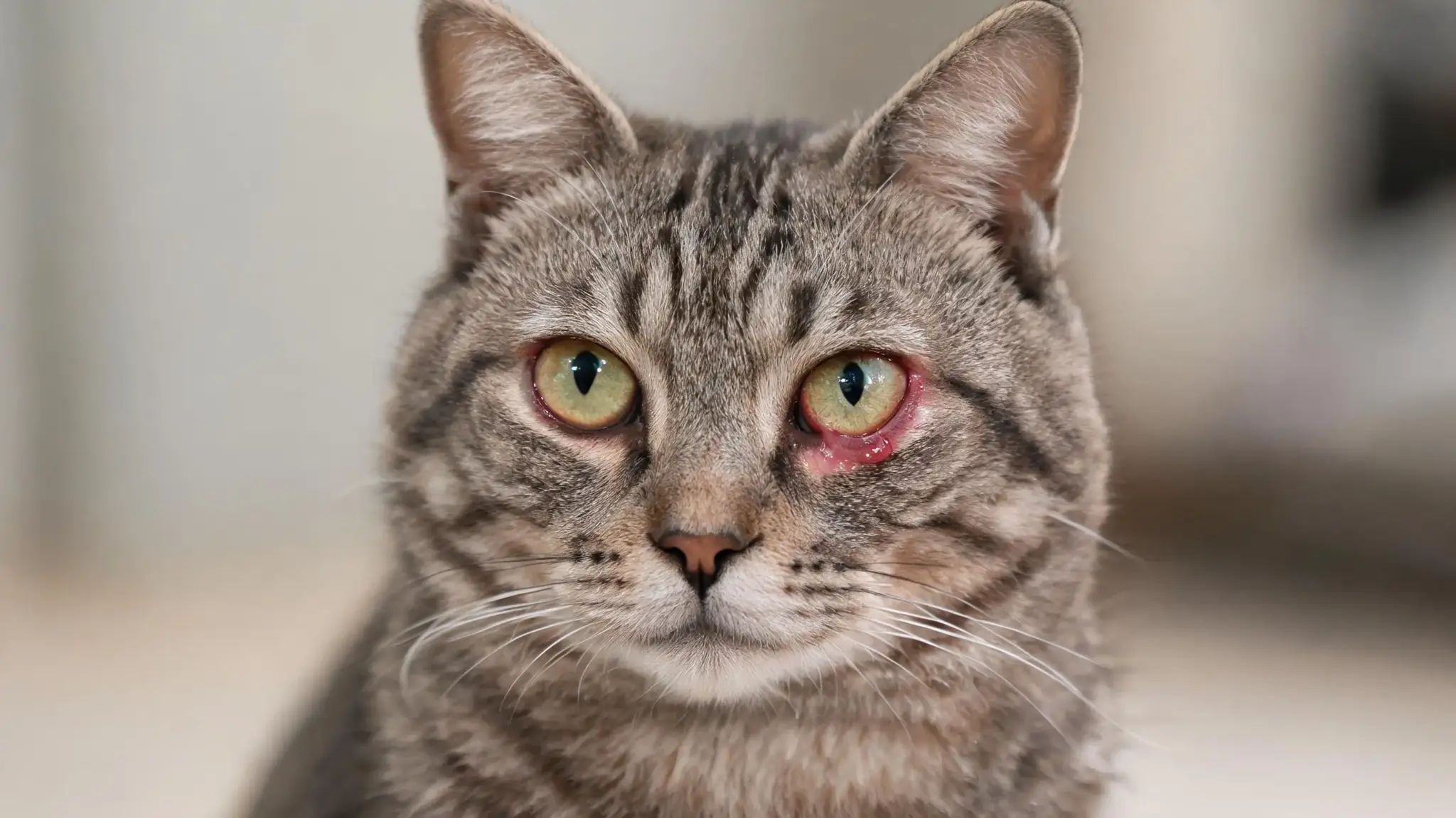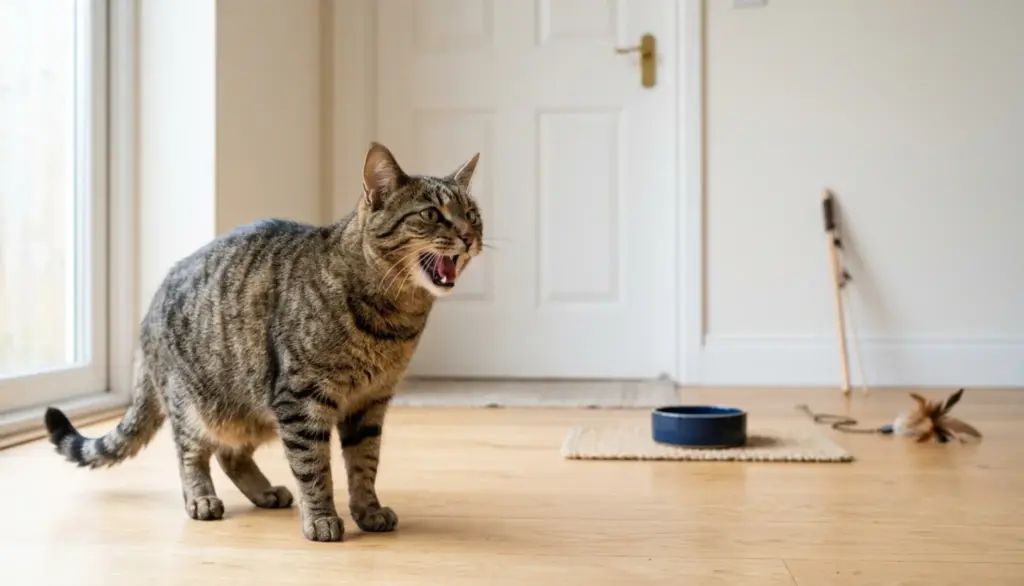
One small call can stop you halfway across a room. A bright greeting sounds very different from the drawn-out cry that sends you checking the food bowl, litter box, and every closed door.
So, why do cats meow? Domestic cats at home use these calls mainly to communicate with people, often asking for food, access, company, play, comfort, or help.
Kittens also vocalize to their mothers, while adult cats rely heavily on scent, posture, and other signals with one another.
No sound has one guaranteed translation. Timing, surroundings, and accompanying actions provide the most useful clues, helping you separate an ordinary request from a sudden change that deserves veterinary attention.
Why Cats Often Meow Directly at People
Meowing is one part of feline communication, alongside scent marking, facial expressions, ear position, tail movement, posture, and physical contact. Among adult house cats, the familiar meow is directed primarily toward people.
A Cornell University study by Nicholas Nicastro tested how accurately people could identify the setting behind recorded calls. Participants performed above chance, but their accuracy remained modest.
Experienced listeners did somewhat better, particularly when hearing several calls together rather than one isolated sound.
The findings explain why no reliable cat-to-human dictionary exists. A call may draw someone’s attention without naming a specific need.
Treat the voice as an alert rather than a complete message. The surrounding situation usually reveals more than pitch or volume alone.
How Feline Communication Changes with the Listener
The role of vocalization varies with the listener and setting. Understanding those differences prevents the misleading claim that cats speak only to people or use the same signals in every social encounter.
1. With People
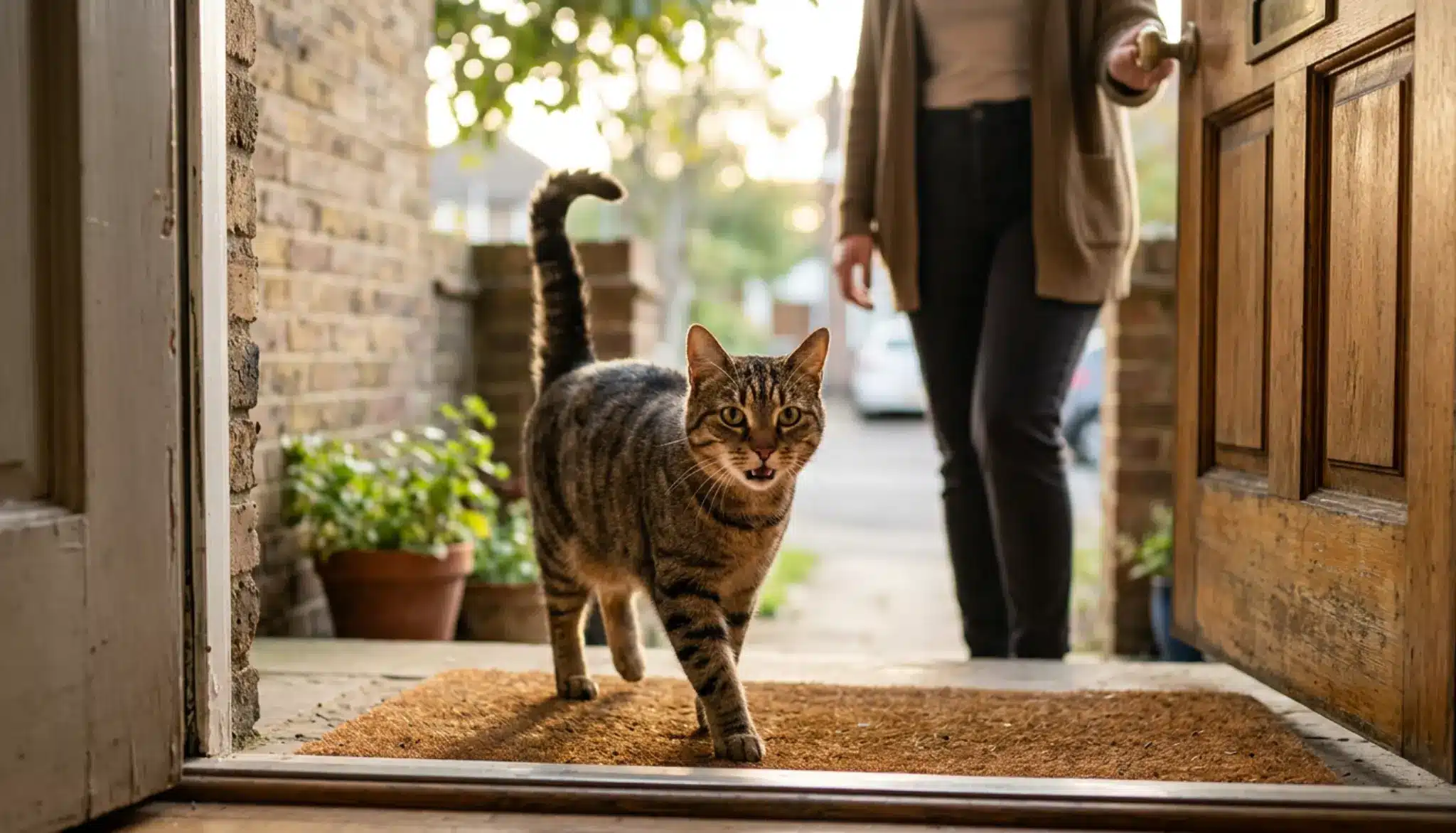
Cats can learn that calling produces a predictable reaction, such as food, play, company, or an open door. However, research does not show that every cat deliberately adjusts specific acoustic features to obtain a particular result.
Over time, caregivers often recognize recurring habits linked with meals, arrivals, or daily routines. Those associations come from repeated interaction rather than a universal feline vocabulary.
2. With Other Adult Cats
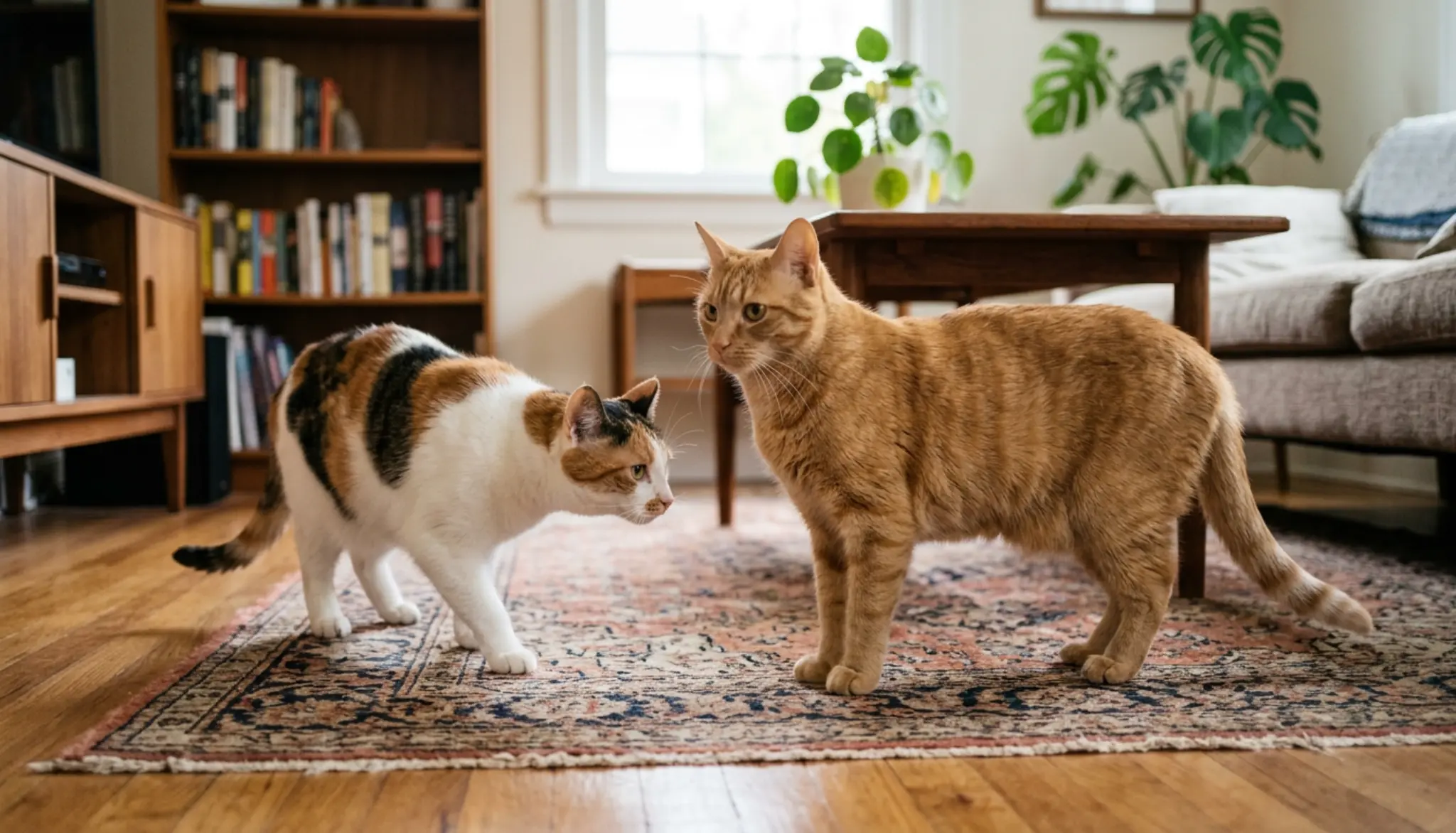
Adult cats rely less on ordinary meows when dealing with other felines. Scent, posture, staring, ear position, tail movement, hissing, growling, and prolonged yowling often carry more useful social information.
Meow-like calls may still occur during close contact, unfamiliar encounters, conflict, or mating activity. Labels vary across veterinary and acoustic research, so “meow” and “yowl” should not always be treated as interchangeable.
3. Between Kittens and Mothers
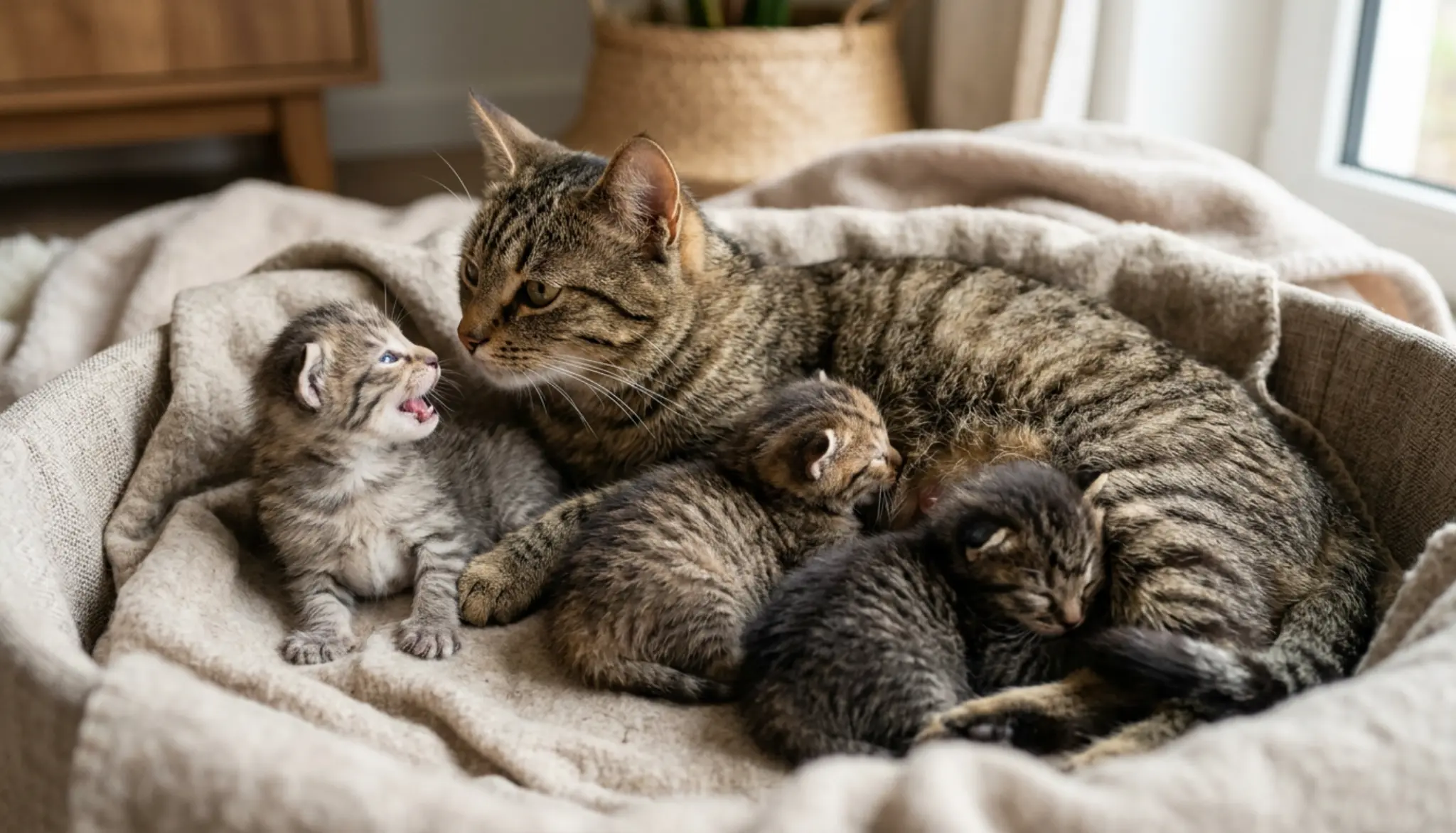
Young kittens call when cold, hungry, separated, or distressed because they depend on their mother for milk, warmth, grooming, and protection. She may respond by approaching, nursing, or retrieving them.
Adult house cats commonly direct calls toward the people who provide food, access, interaction, and comfort. However, the exact developmental link between kitten calls and adult human-directed meowing remains uncertain.
Knowing who the intended listener is helps narrow the possibilities. The next clue is the event or need that prompted the call.
What Your Cat May Be Asking For
Most calls relate to everyday needs, social interaction, environmental changes, or physical discomfort. Looking at where the cat is standing and what happened moments earlier can help identify the likely cause.
| Reason | Typical Situation | Suitable Response |
|---|---|---|
| Greeting | A person enters the room or returns home | Offer a calm acknowledgment |
| Hunger | The call begins near a regular mealtime | Follow the established feeding schedule |
| Play | The cat has rested for several hours and appears alert | Provide a short active play session |
| Company | The cat follows, rubs against, or sits near someone | Offer interaction during a quiet pause |
| Access | A door, window, cabinet, or room is closed | Check if access is safe |
| Stress | A move, visitor, new animal, or routine change has occurred | Identify and reduce the source of tension |
| Mating | An intact cat becomes restless and produces prolonged calls or yowls | Speak with a veterinarian about sterilization |
| Discomfort | Calling begins suddenly alongside physical changes | Arrange a veterinary examination |
More than one factor can be present. A cat may be hungry while also having learned that repeated calling makes breakfast arrive sooner.
The likely cause becomes clearer when sound, location, and timing are considered together. Calls that begin after bedtime often have a smaller group of triggers.
Why Nighttime Meowing Becomes More Common
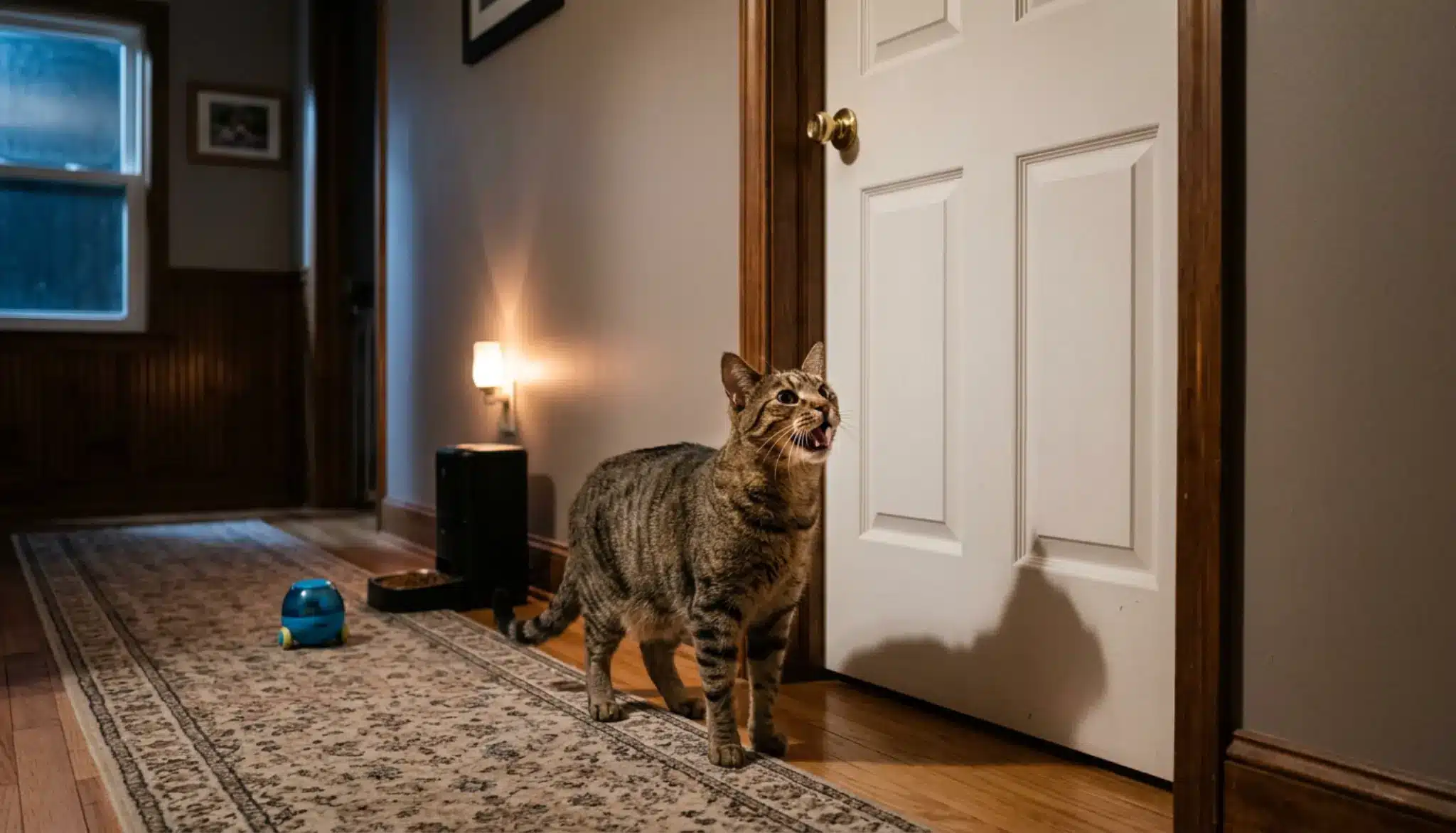
If you keep asking, “why does my cat meow at night?” start by examining activity, feeding times, and previous household reactions. Many nighttime calls come from normal routines or unused energy rather than deliberate misbehavior.
Common causes include:
- Sleeping for much of the day
- Becoming active around dawn or dusk
- Hunger after an early evening meal
- Boredom or limited daytime activity
- Wanting access to a bedroom or another area
- Receiving food or company after earlier nighttime calls
- Mating urges in an unspayed or unneutered cat
An active play session followed by the final meal may help a healthy cat settle. A timed feeder can address early-morning hunger without teaching the cat that waking a person produces food.
Keep meals, play sessions, and bedtime reasonably consistent. If calling starts at a predictable time, offer activity before it normally begins rather than after the noise starts.
New nighttime vocalization in an older cat should be medically assessed before it is treated as a habit. Once illness is ruled out, changes to routine can be made more confidently.
What Different Cat Sounds Can Mean
Pitch, length, and repetition provide clues, but they cannot confirm a cat’s need on their own. These are common associations, not fixed translations, and the same call can occur in several situations.
| Vocalization | Possible Association | What to Check |
|---|---|---|
| One short meow | Greeting, acknowledgment, or simple request | Location and relaxed approach |
| Several quick meows | Heightened arousal or a repeated request | Food, toys, doors, or a returning person |
| Long call | Persistent request, social calling, frustration, or distress | Duration and events before the call |
| High-pitched cry | Surprise, fear, excitement, or discomfort | Sudden movement, conflict, or painful contact |
| Low call | Tension or dissatisfaction | Stiff posture, flattened ears, or tail movement |
| Trill | Friendly contact or movement toward another area | Relaxed posture and direction of travel |
| Yowl | Mating, conflict, disorientation, distress, or pain | Age, duration, symptoms, and nearby animals |
Watch what happens immediately before and after each call. A repeated sound beside a food bowl carries different information from the same sound while the cat hides beneath furniture.
Do not rely on the voice alone. Appetite, movement, grooming, toilet habits, and posture provide stronger evidence when something may be wrong.
When Repeated Meowing Needs Veterinary Care
A naturally talkative cat may be healthy, while an unusual cry from a normally quiet cat may be important. Contact a veterinarian when increased calling appears with:
- Weight loss or increased appetite
- Increased thirst or urination
- Vomiting or diarrhea
- Difficulty walking or jumping
- Hiding, aggression, or reduced grooming
- Confusion, pacing, or sleep changes
- Straining or crying in the litter box
- Breathing trouble, collapse, injury, or severe pain
Repeated straining with little or no urine may indicate a urethral blockage, particularly in male cats. Treat this as an emergency rather than waiting for the symptom to pass.
Record when each episode occurs, how long it lasts, and what the cat does before and afterward. These details can help the veterinarian assess the change.
Health Problems Linked to Increased Vocalization
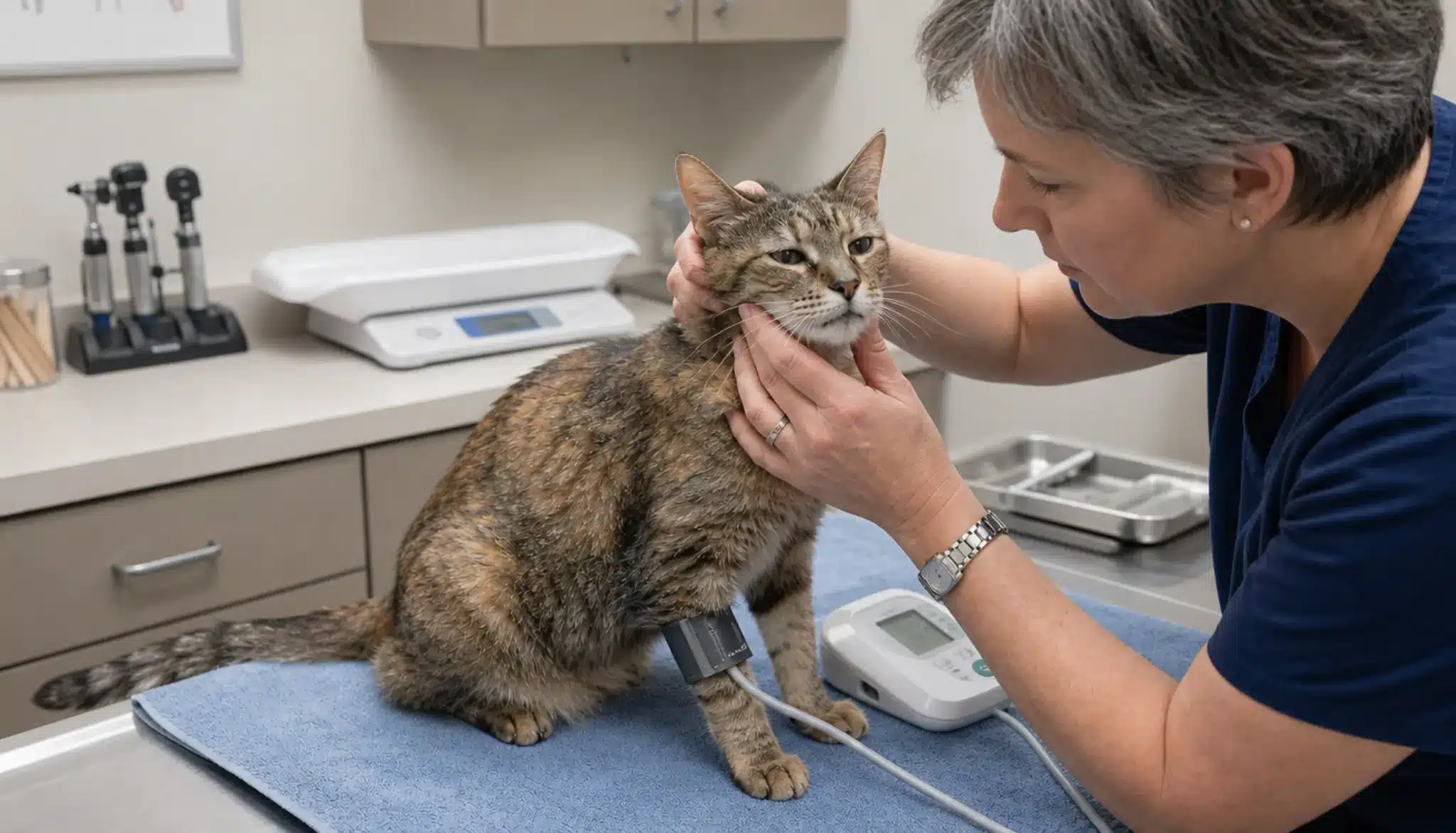
Several health problems can increase a cat’s vocal activity, particularly during older age. A veterinarian may consider the following conditions:
- Pain or discomfort: Arthritis, dental problems, injury, and other painful conditions may cause persistent or distressed calling.
- Hyperthyroidism: An overactive thyroid can cause restlessness and broader behavioral changes. Cornell University research by Molly Bechtold and colleagues documents its physical and metabolic effects.
- Hypertension: High blood pressure may cause anxiety, confusion, vision problems, or unusual vocal activity.
- Sensory loss: Reduced hearing or vision can leave a cat disoriented, causing louder or more frequent calls.
- Cognitive dysfunction: Age-related cognitive decline may affect memory, awareness, and sleep patterns. A Colorado State University survey led by Brittany MacQuiddy found inappropriate vocalization in 40 percent of 80 cats showing signs consistent with the condition.
Increased calling alone cannot confirm any illness. A veterinary examination and suitable tests are needed to identify the cause.
The Bottom Line
A cat’s voice becomes easier to understand when you stop treating each call as a fixed word.
The answer to why do cats meow usually lies in the surrounding moment: dinner is late, a door is closed, play is wanted, stress is present, or something feels physically wrong.
Compare each episode with your cat’s usual routine, posture, appetite, movement, and litter-box habits. Meet genuine needs, maintain predictable feeding and playtimes, and reward quiet pauses rather than demanding calls.
Never punish vocal behavior or dismiss a sudden change as stubbornness. If the calling is new, persistent, distressed, or paired with physical symptoms, contact a veterinarian and begin recording each episode today.
Frequently Asked Questions
Can Cats Understand When People Talk to Them?
Cats can learn familiar sounds, names, routines, and vocal tones, but they do not process sentences exactly as people do. They often combine a person’s voice with gestures, timing, and prior experience to predict what happens next.
Can Cats Recognize Their Own Names?
Many cats can distinguish their names from other spoken words, especially when the name has repeatedly preceded food, affection, or interaction. Recognition does not guarantee a visible response, since a cat may hear the word and choose not to react.
Do Cats Copy Human Voices?
There is no strong evidence that cats imitate human speech. They may vary the pitch or duration of their calls across situations, but describing this as copying a person’s voice goes beyond what current research can reliably confirm.
Can Deaf Cats Still Vocalize?
Yes. Deaf cats can still produce normal vocal sounds, although some call more loudly because they cannot hear or regulate their own volume. A change in hearing may therefore alter both the frequency and intensity of vocal behavior.
What Can Make a Cat Hoarse?
Temporary hoarseness can follow heavy vocal use, but respiratory infection, throat irritation, injury, growths, or other illness may also affect the voice. Arrange a veterinary examination if the change persists or is accompanied by coughing, breathing difficulties, or poor appetite.