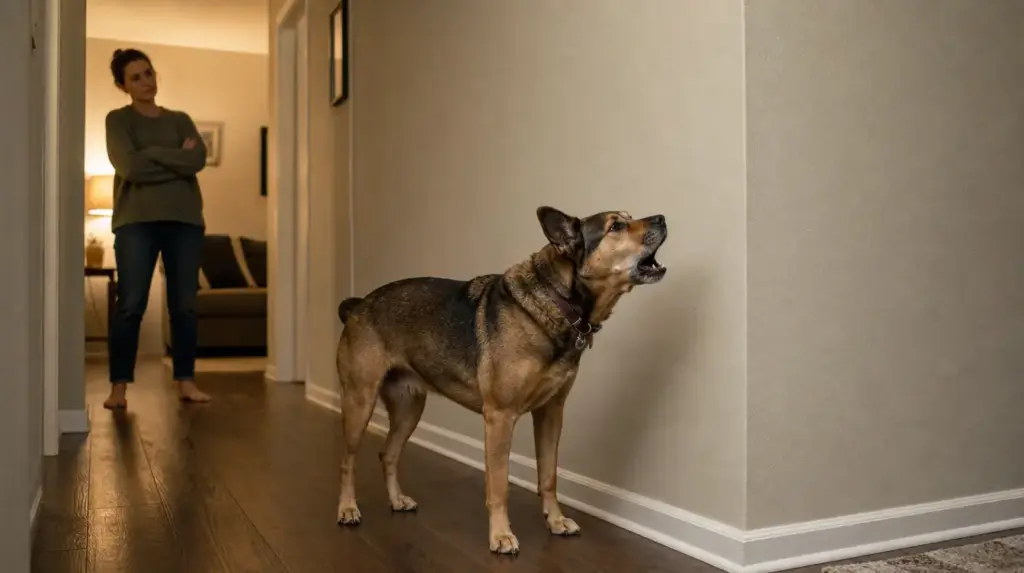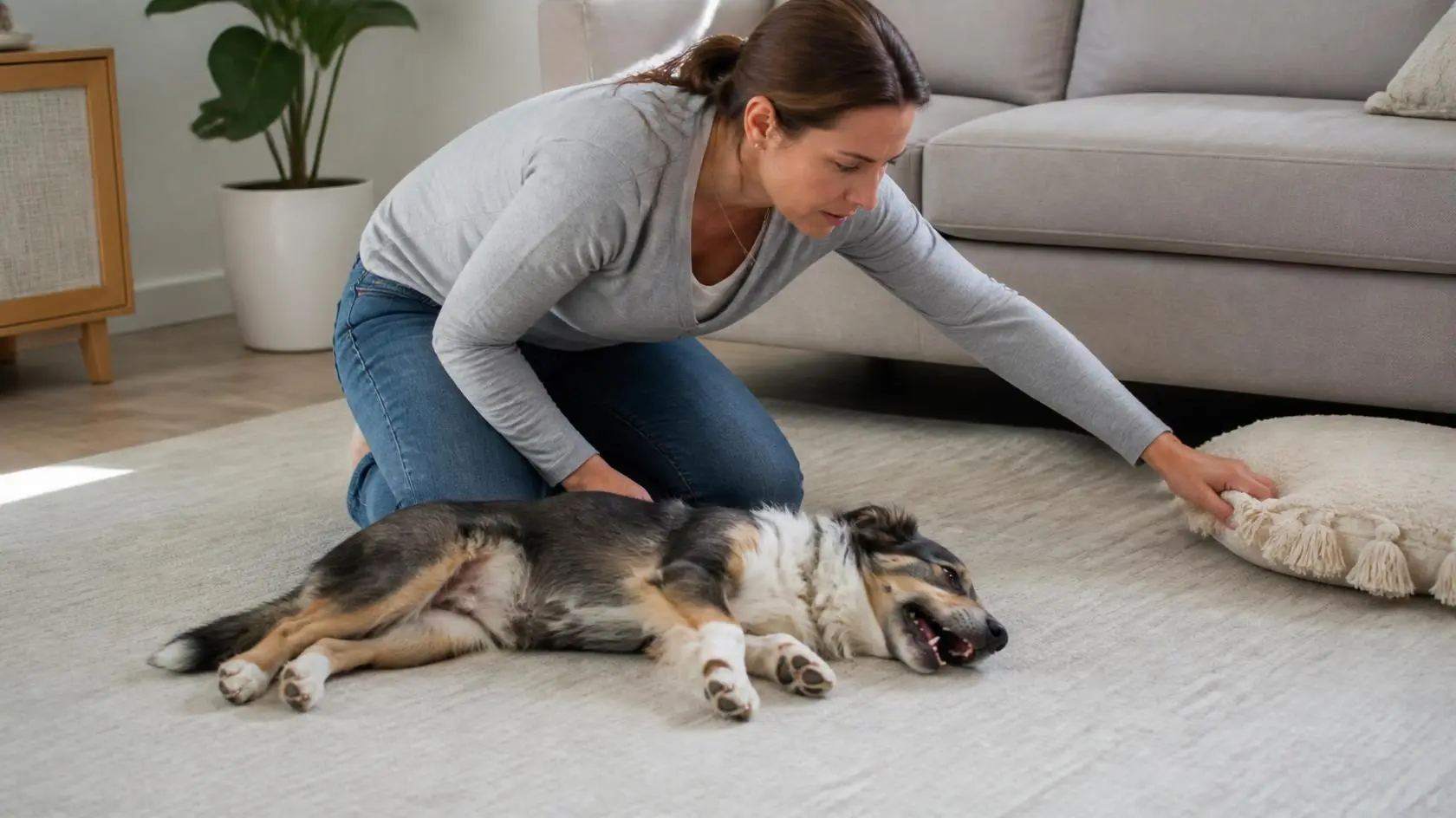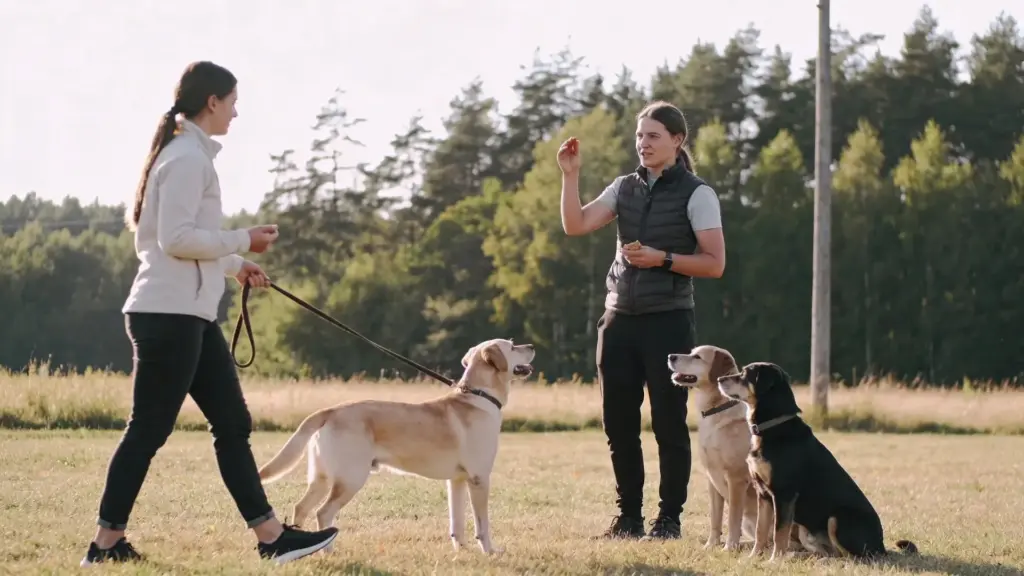
Your dog pulls on the leash, barks at strangers, or refuses to settle indoors. You’ve tried treats, YouTube tutorials, and weekend classes, but nothing sticks.
Meanwhile, your patience is wearing thin, and your stress is climbing. If that sounds like you… You’re not alone, and no, you’re not failing as a dog owner.
Sometimes, dogs need more structure and consistency than busy life allows us to provide. That’s where a dog board and train program steps in.
The concept sounds almost too good to be true. Drop your dog off with a professional trainer for a few weeks, and come home to a calmer, better-behaved companion.
But the reality is more nuanced than this, and knowing those nuances could make the difference between a life-changing experience and an expensive mistake.
In this blog, I’ll explain everything you need to know about dog board and train programs. What they are, how they work, who they’re right for, and how to choose a program you can actually trust.
What is a Dog Board and Train Program?
A dog boarding and training program is a professional service in which your dog stays at a training facility or a trainer’s home for a set period, typically 1 to 4 weeks, while receiving daily hands-on instruction from experienced trainers.
Think of it as an immersive learning environment where training is not just a scheduled session but woven into every walk, meal, and moment of the dog’s day.
Also called a “doggy boot camp” or “residential training,” a dog board and train program pairs that stay with intentional, daily behavioral work.
Unlike weekly group classes or occasional private lessons, where you are juggling both learning to train and actually training your dog at the same time, board and train programs let professional trainers focus entirely on your dog.
This is also quite different from dropping your dog off at a boarding kennel or daycare. Those are primarily care and socialization settings.
Reputable programs integrate training into every part of the dog’s day, managing their environment around the clock to prevent the rehearsal of unwanted behaviors while building new, positive ones.
In my experience, the dogs that make the fastest and most lasting progress are the ones getting consistent feedback all day long, not just during a 45-minute weekly lesson where habits reset the moment they get home.
Types of Dog Board and Train Programs
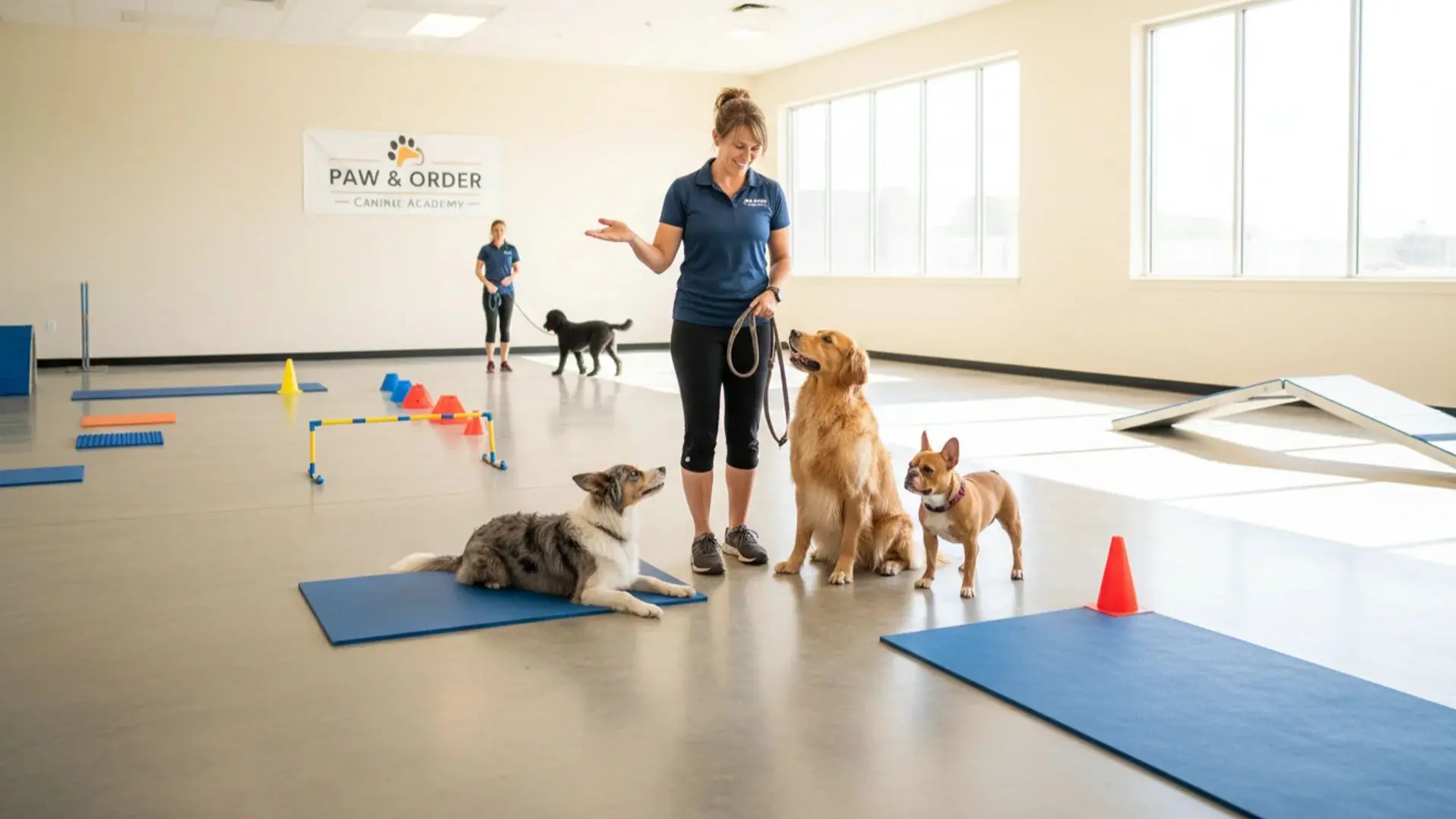
Dog board and train is not one-size-fits-all, and that is actually a good thing. Different dogs need different environments and different approaches based on their individual goals.
- Residential Home-Based Board and Train: Your dog lives in the trainer’s home alongside their family and, often, their own pets. This format teaches real-world manners in a genuine home setting, covering obedience, impulse control, and calm household behavior. It is best suited for dogs who need to learn how to behave in a family environment rather than a facility.
- Facility-Based Board and Train: Your dog stays at a professional training center with structured kenneling between sessions. This covers obedience fundamentals, leash skills, and, in some cases, behavior modification. It is a solid option for dogs with bigger behavioral challenges who benefit from a distraction-controlled, professional environment.
- Group Board and Train Programs: Dogs train alongside other dogs in shared sessions while boarding together. This teaches basic obedience, dog-to-dog social skills, and group focus. It works well for sociable dogs or those who need confidence building around other animals, and tends to be more affordable than private options.
- Private or One-on-One Board and Train: A fully individualized program where the trainer works exclusively with your dog. Addresses specific behavioral goals like reactivity, fear responses, aggression, or separation anxiety. Ideal for dogs with complex behavioral histories or those who get overwhelmed in group settings. This is the format I lean toward for most of the dogs I work with.
- Puppy Board and Train: Designed specifically for puppies in the critical socialization window between roughly 8 and 16 weeks, this program covers crate training, basic commands, bite inhibition, potty introduction, and positive exposure to new environments. It is a great foundation-builder for first-time dog owners who feel overwhelmed by puppyhood.
- Behavior Modification Board and Train: A specialized program targeting deeper behavioral issues like leash reactivity, resource guarding, fearfulness, or aggression toward people or other dogs. Not every board and train facility offers this format, so it is important to ask specifically about the trainer’s experience before enrolling.
- Boot Camp Style Board and Train: Intensive, short-term programs, typically two weeks or less, focused on rapid obedience skill-building. These cover foundational commands, leash manners, and focus. They work well for busy owners who want a strong head start. The owner handoff session becomes even more critical here, given the tight timeline.
What Will My Dog Actually Learn?
One of the most important questions to ask before enrolling, and one that very few board and train guides actually answer clearly, is this: What can a board and train realistically accomplish?
Skills that board and train handles well:
- Foundational obedience commands: sit, down, stay, come, place, heel
- Loose leash walking and leash manners
- Crate comfort and settling behavior
- Impulse control around food, doors, and distractions
- Socialization with people, other dogs, and new environments
- Beginning stages of reactivity and fear reduction
- Off-leash reliability (in longer programs, typically four weeks or more)
Where board and train have real limits:
- Behaviors that are triggered exclusively in your home environment or by you specifically. If your dog only jumps on you and no one else, a residential program will not solve that without your direct involvement in follow-up training.
- Severe separation anxiety. This is a condition rooted in the dog’s attachment to you, and separating them for weeks can, in some cases, intensify the underlying distress rather than resolve it. A behavior consultant working in your home is usually a better fit here.
- Resource guarding is deeply context-specific. Like home-triggered behaviors, this often needs to be addressed within the actual environment where it occurs.
There is also a critical concept that most owners do not hear until after enrollment: dogs do not generalize well.
A dog who learns to wait at a doorway at the training facility does not automatically understand that the same rule applies at your front door.
Skills learned in one environment need to be practiced and reinforced across multiple settings before they truly stick. This is not a flaw in board and train. It is simply how dogs learn. It is one of the biggest reasons the owner handoff session is non-negotiable.
How a Dog Board and Train Program Works
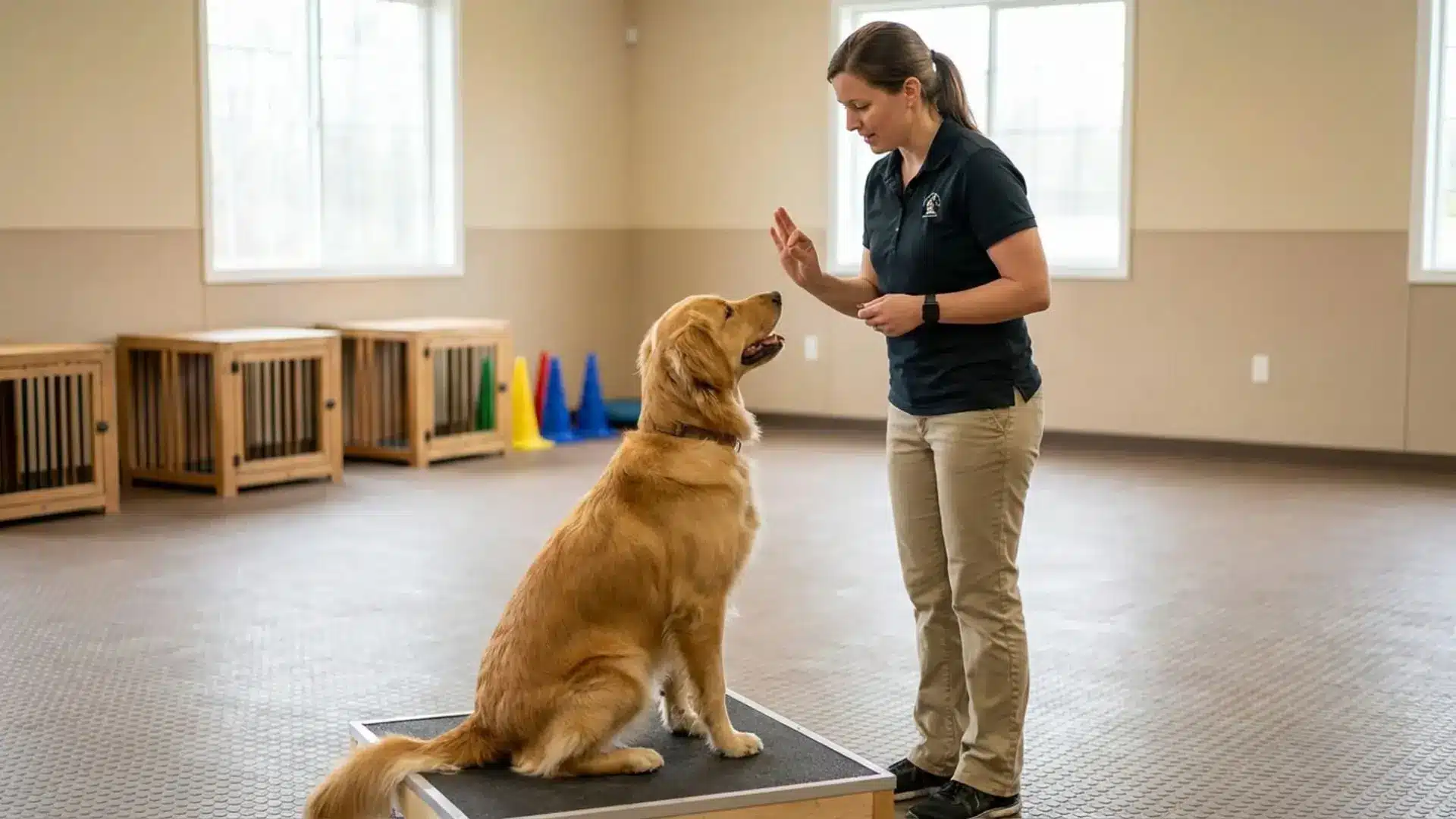
Understanding the structure of a board-and-train program helps set realistic expectations — for you and your dog. Here’s what a well-run program typically looks like from start to finish:
1. The Initial Assessment and Goal Setting
Before your dog even spends their first night, a good trainer will sit down with you and really get to know your dog. Temperament, triggers, history, what has and hasn’t worked before.
This intake conversation matters enormously because it shapes everything that follows. You as the owner get to lay out your goals.
Whether that’s loose leash walking, a reliable recall, crate comfort, or working through something more complex like reactivity. The clearer you are upfront, the more targeted the program can be.
2. Daily Training Routines During the Stay
This is where the immersive part truly comes to life. Rather than one concentrated session, your dog is learning across the entire day in short, focused bursts.
Modern reward-based training works best this way because dogs retain more when practice is spread out and low-pressure. Between sessions, there is structured rest, socialization, and play.
Most reputable trainers will also send you progress videos throughout the stay, so you are never left wondering how your dog is doing.
3. The Owner Handoff and Transition Training
This is the phase I feel most strongly about and, honestly, the one that gets skipped most often. When your dog comes home, the learning does not stop. It transfers to you.
A proper handoff session walks you through every cue your dog has learned, how to reinforce it correctly, and what to do if things slip.
Without this, even the best-trained dog can lose their new skills within weeks because the environment has changed and the reinforcement history has reset.
The dog board-and-train program plants the seed, but you are the one who grows it once they are back home.
Pros and Cons of Dog Board and Train
As a trainer, I believe in giving dog owners the full, honest picture. Dog board and train programs can be genuinely life-changing, but they are not right for every dog or every family.
| Pros | Cons |
|---|---|
| Intensive daily training produces faster results than weekly lessons | Dogs may not transfer learned behavior easily to a home environment |
| Consistent environment reduces distractions during learning | Owner consistency is required or training may fade |
| Trainer can quickly identify root behavior issues | Not suitable for dogs with severe separation anxiety |
| Suitable for busy owners with limited time | No strict regulation in the industry |
| Helpful for owners with physical limitations | Some programs rely on harsh or quick-fix training methods |
| Trainer observes the dog continuously for deeper insights | High cost does not always reflect quality |
| Encourages socialization with people, animals, and new environments | Owners must trust the trainer without seeing the full process |
How to Choose a Reputable Dog Board and Train Trainer
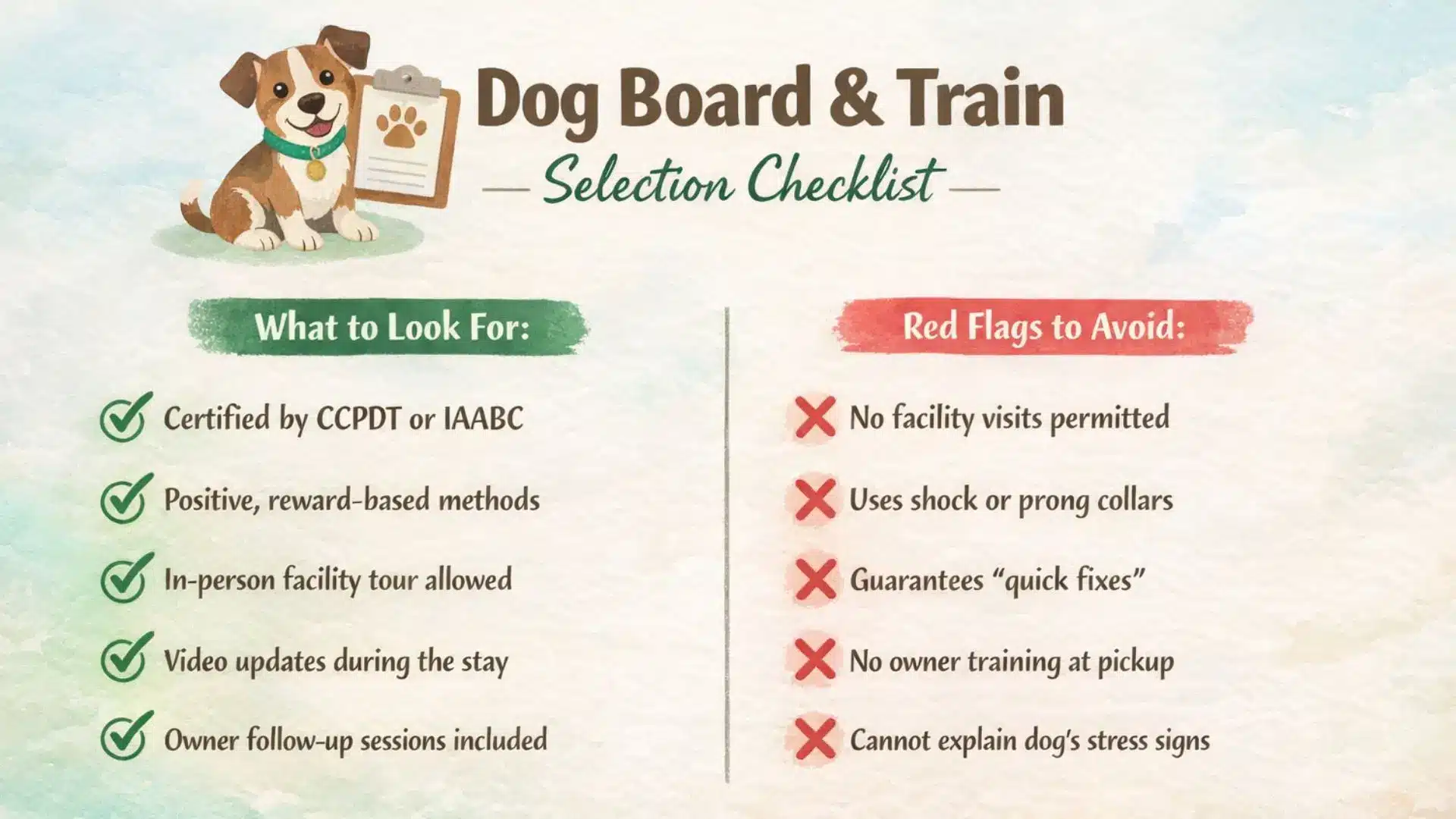
Since the dog training industry is currently unregulated in the United States, anyone can call themselves a trainer and offer board and train services .
This makes your vetting process critically important. The Certification Council for Professional Dog Trainers(CCPDT) maintains a searchable directory of certified trainers, which is a solid starting point when you are evaluating your options.
Begin with credentials. Look for trainers certified through recognized bodies like the CCPDT or affiliated with the International Association of Animal Behavior Consultants(IAABC).
These certifications require demonstrated knowledge, hands-on experience, and a commitment to continuing education.
A reliable program should welcome in-person visits before enrollment, giving you a clear view of the environment, the daily setup, and how the dogs currently in the program are handled.
Training methods should be explained in plain terms and rooted in positive reinforcement and behavioral science. The American Veterinary Society of Animal Behavior(AVSAB) recommends reward-based methods as the standard for ethical training, which is a good benchmark to hold any trainer to.
During the stay, consistent video updates should show real progress. At pickup, a structured go-home session should prepare you to continue the work at home.
When visiting a facility, pay close attention to how the dogs already in the program are behaving. Calm, engaged dogs who are focused on their trainer are a good sign.
Dogs that look shut down, avoidant, or stressed are not, and that is worth taking seriously, regardless of how polished the facility looks or how confident the trainer sounds.
Red flags to walk away from:
- Trainer refuses a facility visit or is vague about daily routines
- Cannot explain their methods in plain, simple language
- Relies on shock collars, prong corrections, or dominance-based techniques as a default
- Offers guaranteed results in an unusually short timeframe
- No structured owner education session at the end of the program
- Staff cannot identify or describe basic stress signals in dogs
- No written training plan or post-program follow-up offered
How Much Does a Dog Board and Train Cost?
Cost varies widely depending on your location, the trainer’s credentials, program length, and the living environment your dog stays in.
| Program Type | Duration | Estimated Cost |
|---|---|---|
| Basic Obedience / Puppy Program | 1-2 weeks | $1,000 – $2,500 |
| Intermediate Obedience | 2-3 weeks | $2,000 – $3,500 |
| Behavior Modification (reactivity, fear) | 3-5 weeks | $3,000 – $5,000+ |
| Advanced / Off-Leash Training | 4-8 weeks | $3,500 – $6,000+ |
As a dog parent, you always need to remember that a higher price tag doesn’t automatically mean a better or safer program.
Some costly programs use aversive tools to produce fast, surface-level results. Focus on credentials, methodology, and transparency, not just the price.
It is also worth noting that geographic location plays a significant role. Programs in major metropolitan areas tend to run on the higher end of these ranges, while trainers in smaller cities or rural areas may offer comparable quality at a lower price point.
Always compare what is included: the number of training sessions per day, whether follow-up lessons are built into the price, and what the housing conditions actually look like.
What Dog Owners Say About Dog Board and Train
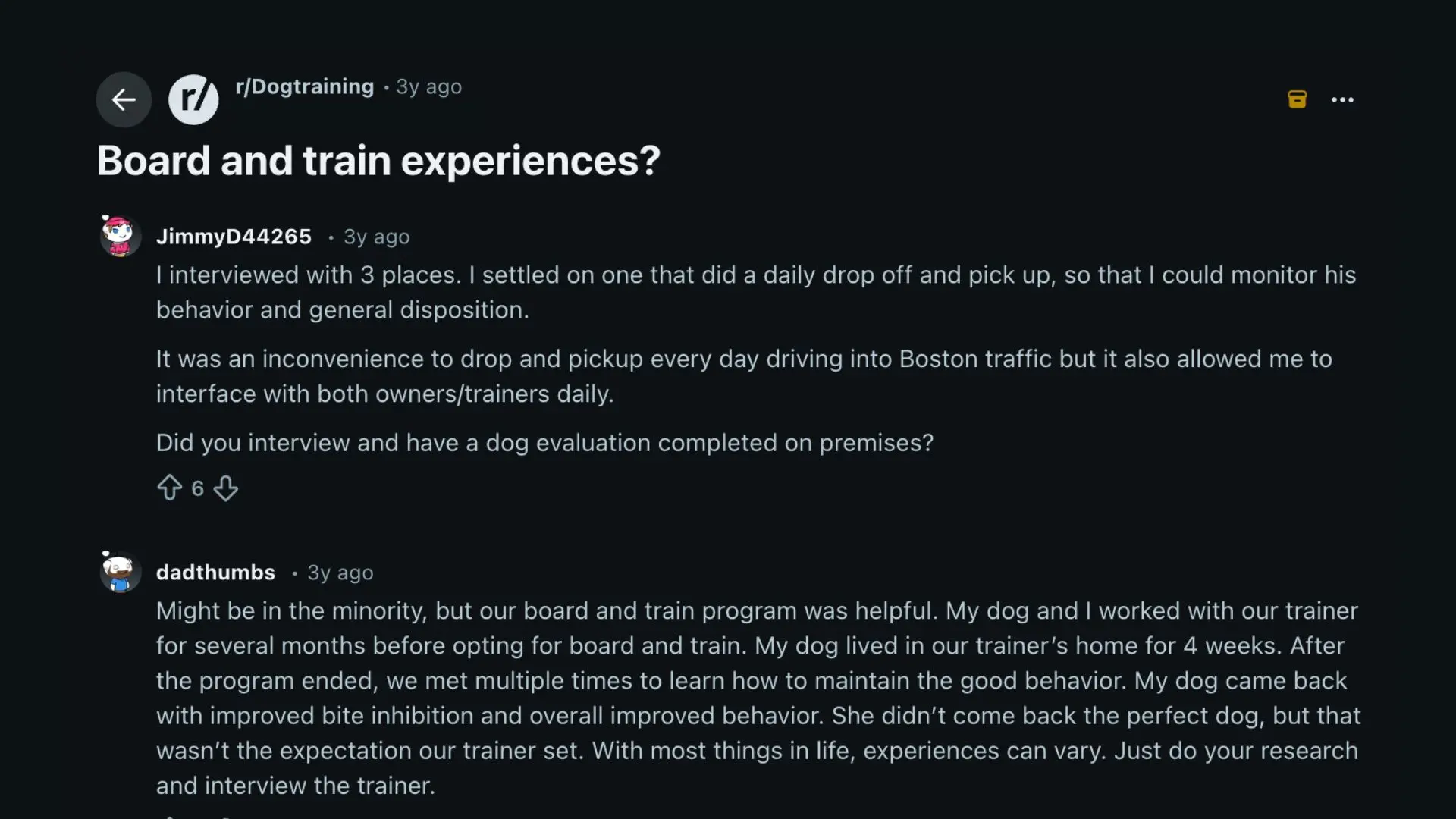
I always tell pet parents that hearing straight from other dog owners makes all the difference when you are thinking about a board and train program.
On Reddit, people shared their real-life stories without holding back. Most folks strongly advised against it.
They explained that even after touring the facility and asking plenty of questions, you still have no real way of knowing exactly how your dog is treated when you are not there.
Several owners described their dogs coming home more anxious or shut down than when they left, with new fears that seemed to stem from the training methods used behind closed doors.
A few people did report some success, especially when the program stuck to gentle, reward-based techniques and included solid follow-up sessions for the family.
Their dogs picked up basic commands and manners that lasted once they got home. Yet even those happier stories came with a big caveat that the skills often needed lots of extra practice at home to truly stick.
From my 14 years working hands-on with hundreds of dogs, this mix of feedback rings true. It shows that a dog board-and-train can work well for the right dog and the right trainer.
At the same time, it also carries real risks if transparency or positive reinforcement is missing. That is why I always urge families to dig deep, ask for references, and make sure the program feels like a true partnership before they decide.
Is a Board-and-Train Right for Your Dog?
Board-and-train programs work best in certain situations. Ask yourself the following questions to gauge whether this option is a good fit:
Board and Train is often a great fit when:
- Your schedule doesn’t allow for daily, consistent training sessions at home
- Your dog has a physical disability-related owner, or the owner does
- Your dog has complex behavior issues like reactivity, leash aggression, or fearfulness that need expert daily management
- You’ve tried group classes or private lessons without lasting success
- You want a strong behavioral foundation built quickly in a young puppy
- Specific environments or people are triggering problematic behaviors that need to be addressed in a controlled setting
Board and Train may NOT be the best fit when:
- Your dog has severe separation anxiety that could be significantly worsened by the separation
- You want to be deeply involved in every step of the training process
- The behavior issue is primarily triggered by your home environment or your specific interactions; in that case, in-home training may be more effective
- You aren’t able or willing to commit to maintaining the training after your dog returns home
Note: One common mistake is thinking the program does all the work. Board and train gives your dog a strong head start with a solid foundation. But you decide if those skills last or fade. Your dog learned with the trainer, now they must learn with you. The go-home lesson is not optional, it’s essential
Conclusion
A well-run dog board and train program can be one of the most effective investments you make in your dog’s well-being and your relationship with them.
I’ve seen dogs go from unmanageable and fearful to confident and calm companions, and I’ve watched the tears of relief on owners’ faces at pickup. Those transformations are real and possible.
But they require the right program, the right trainer, and perhaps most importantly, a committed owner on the other end.
Do your homework, ask the hard questions, and don’t be swayed by big promises or low prices alone. Your dog trusts you to make the right call. With this guide, you now have everything you need to make it.
Have questions about dog boarding and training programs, or need help evaluating a facility near you? Drop your questions in the comments below.
Frequently Asked Questions
Can I Visit My Dog During the Board and Train Program?
Most trainers discourage mid-program visits because they can disrupt progress and trigger separation-related stress in dogs that have already settled in. Daily video updates are typically provided instead, so you stay informed throughout the stay.
Will My Dog Forget Me After a Month Away?
No. Dogs have strong long-term memories for the people they are bonded to. Your dog will be genuinely excited to see you at pickup, and that bond does not weaken during a training stay.
Do Facilities Require Specific Dog Vaccinations Beforehand?
Yes, reputable facilities mandate up-to-date rabies, distemper, parvo, and bordetella vaccines to ensure the health of all animals on site.
How Soon Can I Enroll My Newly Adopted Rescue in Dog Board and Train?
Wait at least 3 to 4 weeks. Rescue dogs need time to decompress, adjust to their new home, and begin building a bond with you before undergoing an intensive residential program. Enrolling too early can add stress to an already significant transition.