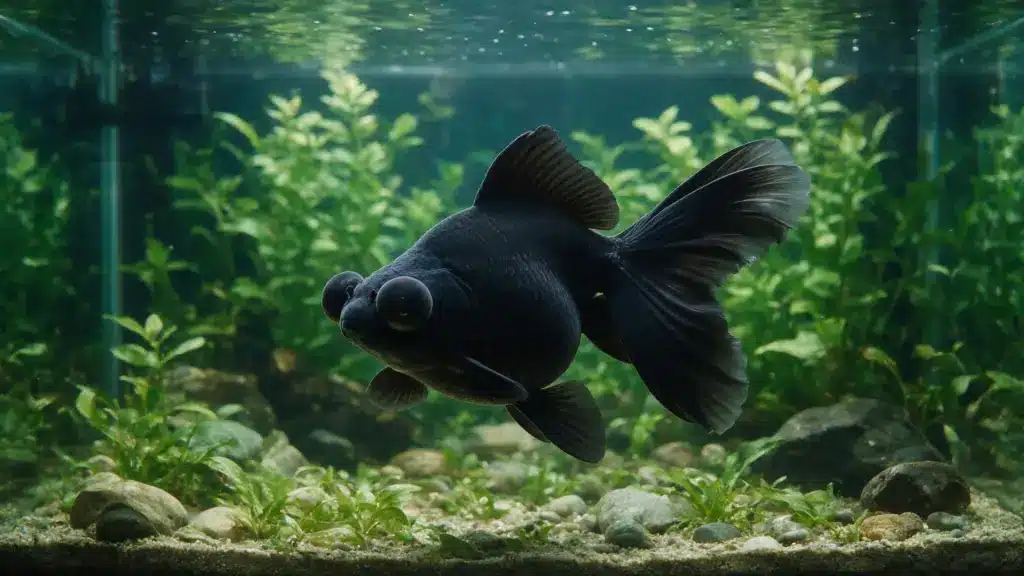
I’ve treated more than a few Black Moors over the years, and they’re usually brought in for the same reason: an eye injury from a sharp decoration nobody thought twice about.
That’s the thing about this breed: their most striking feature is also their most fragile one, and it shapes almost every care decision you’ll make for them.
Black Moors see less clearly and swim more slowly than common goldfish, so they need open space, smooth furnishings, and easy access to food.
With a properly cycled tank, stable water, and the right companions, this genuinely gentle fish can be part of your household for well over a decade.
What Does a Black Moor Goldfish Look Like?
The Black Moor has a short, rounded body, paired fins, and a broad double tail trailing behind it. Its most recognizable feature is those eyes, projecting from both sides of the head.
Those telescope eyes limit sight and are easier to injure than the eyes of a streamlined common or comet goldfish, which is exactly why so much of their care setup revolves around protecting them.
Color can range from deep black to gray-black or bronze. Young fish often look bronze or gray before darkening with age, and some adults slowly develop orange or gold patches over time.
A gradual color shift in a fish that’s eating and swimming normally isn’t automatically a sign of trouble. Redness, sores, missing scales, or sudden patches of damage are what actually deserve a closer look.
Most adults reach about 6 to 8 inches, though individual size varies. Their deep body and long fins make them slower and less agile than single-tailed goldfish, worth remembering when you’re thinking about tank mates and swimming space.
Black Moor Goldfish Overview
These quick facts show what an adult Black Moor generally needs and how much long-term care a new owner should expect.
| Trait | Information |
|---|---|
| Scientific name | Carassius auratus |
| Goldfish group | Fancy telescope goldfish |
| Adult size | Commonly about 6 to 8 inches |
| Expected lifespan | Often about 10 to 15 years |
| Temperament | Peaceful and slow-moving |
| Diet | Omnivorous |
| Care level | Moderate |
| Main feature | Protruding telescope eyes |
| Suitable companions | Similar-sized, slow-moving fancy goldfish |
These numbers are planning ranges, not promises. Genetics, food, aquarium size, water quality, and access to veterinary care can all affect growth and longevity.
How to Set Up a Tank for Black Moor Goldfish
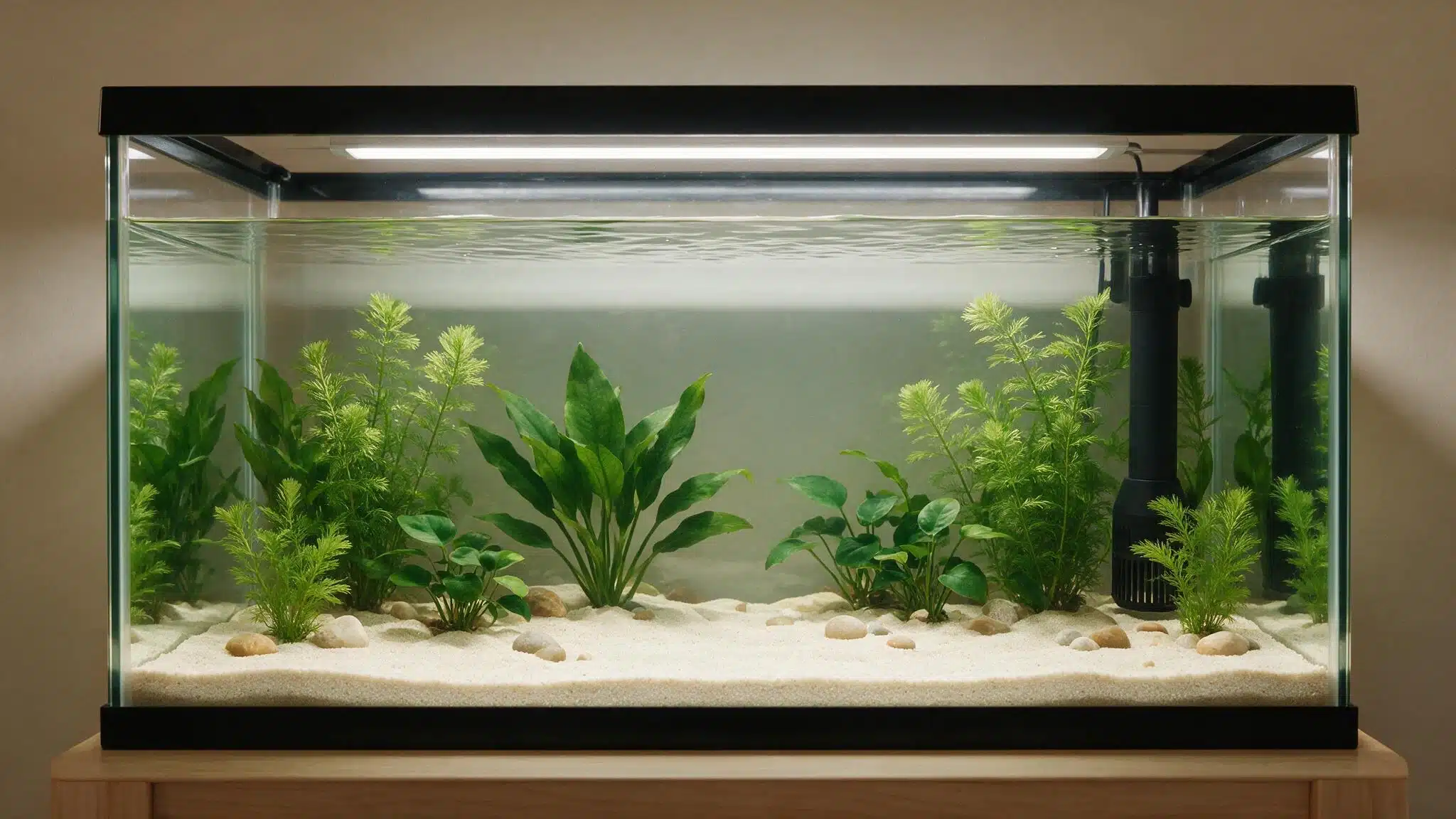
A suitable aquarium provides open swimming room, established biological filtration, stable water, and smooth objects that are unlikely to injure the fish’s eyes or fins.
1. Tank Size and Swimming Space
A practical starting point is about 20 to 30 gallons for one adult, with additional room and filtration for every extra goldfish. Treat this as a planning range rather than a fixed stocking formula. Tank shape, usable swimming space, filter capacity, and maintenance all matter.
A bowl or small container holds too little water to dilute waste reliably, and conditions can change quickly. Plan for the fish’s adult body, not the small size seen at the store.
2. Water Conditions
Aim for cool, stable freshwater at roughly 65°F to 75°F, with a pH around 7.0 to 8.0. Ammonia and nitrite should read 0 ppm, while nitrate should be kept low through testing and partial water changes.
These water-quality basics are important for other varieties too, especially for anyone still learning how to care for goldfish and maintain a stable aquarium.
Treat tap water with a conditioner that handles chlorine or chloramine before it enters the tank. Avoid repeatedly adding chemicals to reach one exact pH value. A stable reading within a suitable range is usually safer than frequent swings.
3. Filtration and Water Movement
Goldfish produce substantial waste, so the filter must provide mechanical filtration for debris and biological filtration for toxic waste compounds.
Filtration works alongside regular maintenance, and cleaning a fish tank properly means removing waste without disrupting the beneficial bacteria that help keep the aquarium stable.
Use enough surface movement for gas exchange, but keep the current gentle to moderate. A strong stream can exhaust a slow fancy goldfish.
Protect an intake that could pull at long fins. Remember that simply running a new filter for several days does not complete the nitrogen cycle. Test ammonia and nitrite before introducing the fish.
4. Substrate, Plants, and Decorations
Smooth sand, a bare bottom, or stones too large to swallow are safer choices. Select rounded ornaments with wide openings, stable bases, and no rough seams. Leave clear routes between furnishings so a poorly sighted fish does not become trapped.
Soft artificial plants or suitable live plants can add cover, although goldfish may nibble or uproot them. Keep the aquarium away from direct sunlight, which can cause temperature changes and heavier algae growth.
Eye safety and easy movement should guide the position, shape, and spacing of every item placed inside the aquarium.
What Should Black Moor Goldfish Eat?
Black Moors need measured portions of balanced goldfish food, with small amounts of suitable vegetable and animal-based foods for variety.
- Use a good-quality sinking pellet or gel food as the staple.
- Choose pieces that fit comfortably inside the fish’s mouth.
- Soften hard pellets when needed.
- Offer small portions once or twice a day.
- Give only what the fish can finish promptly, then remove leftovers.
- Add small servings of softened leafy greens, shelled peas, or blanched zucchini.
- Offer daphnia, brine shrimp, bloodworms, or suitable frozen food occasionally.
- Place food where the fish can locate it without hitting decorations.
- Watch group feeding so faster tank mates do not take every bite.
Good care for Black Moor goldfish includes resisting their frequent begging. Excess food adds waste to the water and may contribute to digestive trouble or abnormal swimming.
Which Fish Can Live With Black Moors?
The safest tank mates share a similar body size, swimming speed, food needs, and calm temperament. Compatibility matters a lot more than just picking another cool-water species.
| Tank Mate | Suitability | Main Consideration |
|---|---|---|
| Fantail goldfish | Good | Similar swimming speed |
| Telescope goldfish | Good | Similar sight and movement limits |
| Oranda goldfish | Usually good | Food access needs monitoring |
| Ranchu goldfish | Usually good | Benefits from gentle water movement |
| Ryukin goldfish | Possible | Watch for chasing and food competition |
| Common goldfish | Poor match | Usually faster and more competitive |
| Comet goldfish | Poor match | Swims faster and needs more room |
| Fin-nipping fish | Unsuitable | May damage the eyes or fins |
| Very small fish | Risky | May be swallowed or stressed |
| Plecos | Usually unsuitable | Some may attach to slow goldfish |
Check your available tank capacity before adding anyone new, and once you do, watch their feeding and swimming rather than assuming every individual fish will act exactly like its type suggests.
How to Maintain a Black Moor Aquarium
A simple routine keeps waste from building up and makes small changes easier to notice before they become larger problems.
- Daily: Check appetite, breathing, swimming, temperature, filter flow, eyes, and fins.
- Weekly: Test the water, remove visible debris, clean the viewing glass, and complete an appropriate partial water change.
- Monthly: Inspect tubing, the filter impeller, air equipment, plants, and decorations for wear or trapped waste.
- As needed: Rinse reusable filter media gently in water removed from the aquarium, not untreated tap water.
Condition all replacement tap water and keep it close to the tank’s temperature. Do not replace every piece of biological filter media at once, and do not empty and scrub the full tank during routine cleaning.
If appetite, breathing, or swimming changes, test the water immediately instead of waiting for the usual maintenance day. The RSPCA goldfish care advice also stresses filtration, routine water checks, and partial water changes.
Common Health Problems in Black Moor Goldfish
Changes in appetite, breathing, swimming, or appearance can have several causes. Test the water first, then assess the fish and its surroundings.
1. Eye Injuries and Cloudiness
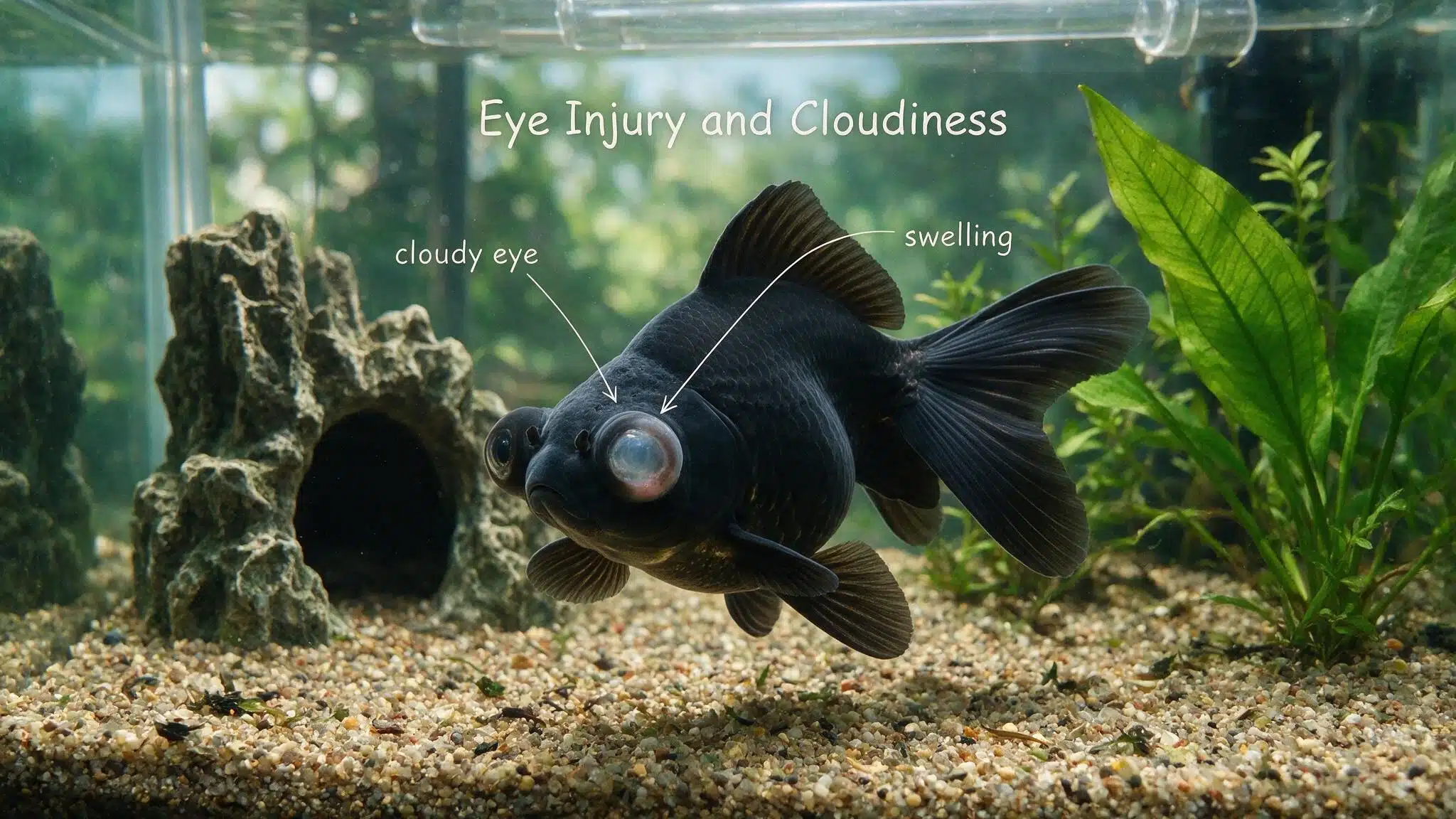
Scratches, swelling, cloudiness, bleeding, or a change affecting one eye may follow a collision, rough ornament, narrow opening, aggressive fish, or unsafe handling.
Check both the tank layout and water readings. Persistent cloudiness, active bleeding, marked swelling, or worsening damage needs assessment from a veterinarian who treats fish.
2. Buoyancy and Swimming Problems
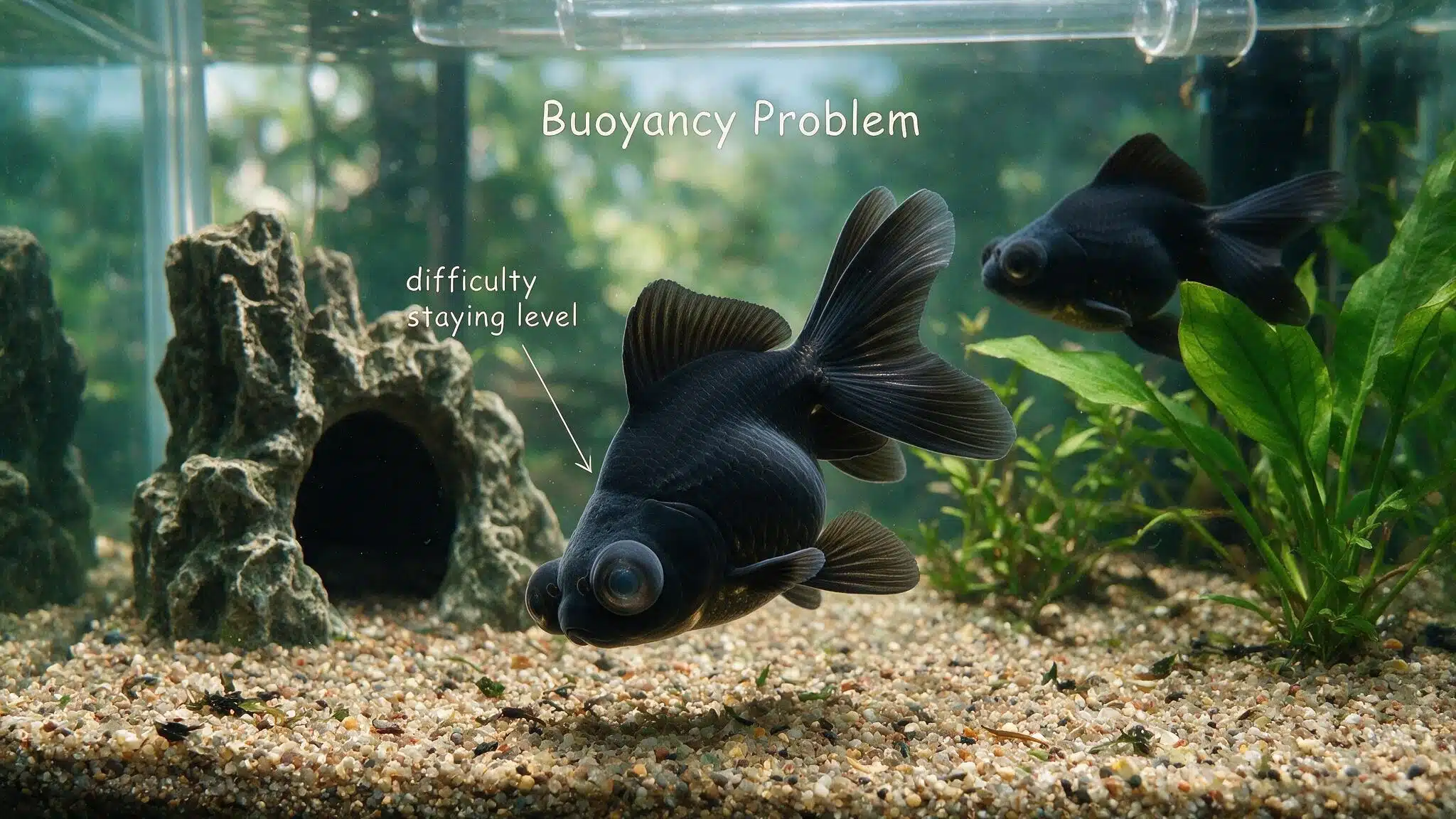
Floating, sinking, rolling, or struggling to remain level does not point to one single disease. Diet, constipation, body shape, infection, organ trouble, and poor water quality can produce similar signs.
Test ammonia, nitrite, nitrate, pH, and temperature. Persistent or severe trouble needs qualified assessment rather than random medication.
3. Ich, Fin Damage, and Infection
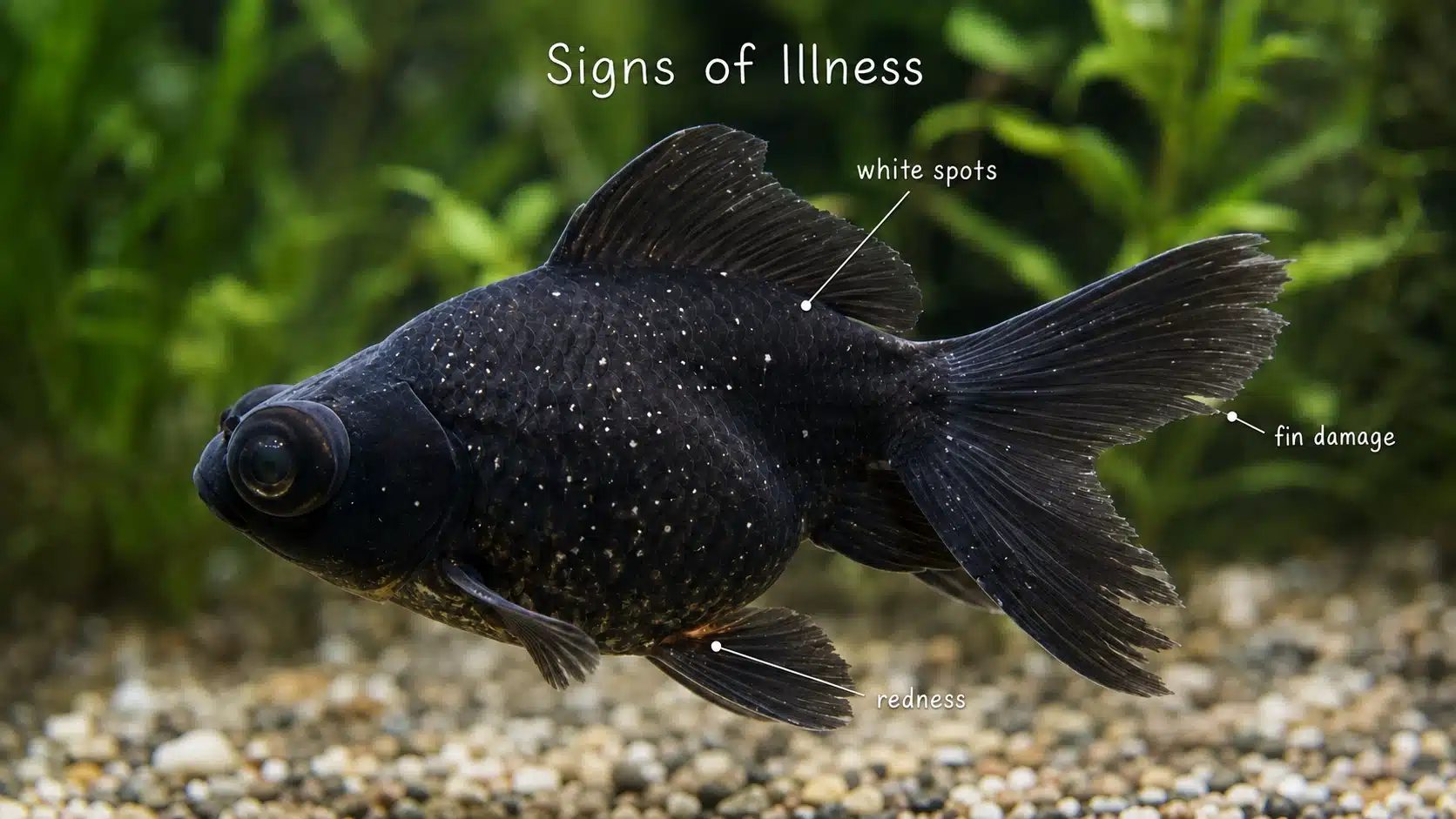
White spots, rubbing, clamped fins, rapid breathing, redness, frayed fins, sores, and appetite loss can overlap across parasites, injury, poor water conditions, and infection. Quarantine new fish when practical.
The Merck Veterinary Manual fish health resource explains why diagnosis depends on the fish’s history, water conditions, and clinical signs.
When to get professional help: Contact a veterinarian who treats fish if you notice persistent cloudiness, bleeding, major swelling or eye damage, severe buoyancy problems, labored breathing, open sores, repeated rolling, inability to stay upright, or rapid decline. Getting expert help early is safer than relying on trial-and-error treatments.
Black Moor Goldfish Size, Lifespan, and Color Changes
Adult Black Moors commonly reach about 6 to 8 inches, though genetics and living conditions can lead to smaller or larger fish. A juvenile bought at only a few inches long still needs a tank planned for adult growth.
Many Black Moors live about 10 to 15 years under suitable care, and some may live longer. Water quality, tank space, diet, disease, genetics, and access to treatment all affect the outcome. A short life should not be accepted as unavoidable simply because goldfish are often sold as small pets.
Young Black Moors may start out gray or bronze before becoming darker. Some adults later gain orange, bronze, or gold areas. Slow pigment change in a fish that eats, breathes, and swims normally may be natural.
Sudden patches paired with sores, lost scales, lethargy, poor appetite, or abnormal breathing call for a water check and closer examination.
Are Black Moor Goldfish Good for Beginners?
Black Moors can suit prepared beginners, but they are not effortless pets. Their waste output, long lifespan, slow swimming, and exposed eyes require steady care.
Before buying one, confirm that you can:
- Cycle the aquarium before introducing the fish.
- Provide enough water volume and open swimming space.
- Run effective filtration without an exhausting current.
- Test ammonia, nitrite, nitrate, pH, and temperature.
- Complete regular partial water changes.
- Choose smooth, eye-safe furnishings.
- Control portions and monitor access to food.
- Select slow-moving companions.
- Commit to care that may last well over a decade.
This fish is a poor fit for anyone hoping for a bowl pet, an unfiltered container, or a tank that gets minimal upkeep. Setting up the full system first makes beginner ownership genuinely manageable, rather than a constant scramble to fix problems after they show up.
The Bottom Line
A Black Moor needs more than attractive decor and a daily sprinkle of food. Start with a spacious, fully cycled aquarium, effective filtration, and water that stays clean and stable.
Keep the layout open and use smooth furnishings to protect those telescope eyes. Feed controlled portions where your fish can actually find them, and pair them only with calm companions that won’t steal every bite.
A bowl simply can’t provide the swimming room or water stability this fish needs for the long haul. Gradual color change is usually nothing to worry about, but sudden physical or behavioral changes deserve prompt attention.
Set up, cycle, and test the complete aquarium before the fish ever comes home; future you will thank present you for the patience.
Frequently Asked Questions
Can Black Moor Goldfish Live Alone?
Yes. One can live alone when its space, stimulation, and environmental needs are met. Add a compatible companion only when the aquarium has enough swimming room and filtration for both fish.
Do Black Moor Goldfish Need a Heater?
Not always. A heater may be unnecessary in a stable indoor room, but it can help prevent sharp temperature drops in colder homes. Monitor the water with a dependable aquarium thermometer.
Can Black Moor Goldfish Live in a Bowl?
No. Most bowls lack adequate swimming room, water volume, filtration, and gas exchange. Waste can build quickly, making long-term water quality difficult to keep safe and stable.
Why is My Black Moor Turning Orange?
Gradual orange coloring may relate to genetics, age, light, or normal pigment change. Sudden raw patches, missing scales, low appetite, or unusual breathing need closer attention.
How Often Should Black Moor Goldfish Be Fed?
Feed small portions once or twice daily. Adjust the amount for fish size, food type, activity, and temperature, and remove anything the fish does not finish promptly.