
I’ve walked into basements and attics where something scurried away, leaving me wondering what I just saw.
Was it a rat or a mouse? The truth is, many people struggle to tell them apart, and that confusion can lead to the wrong pest control approach.
As a licensed veterinarian with years of clinical experience in Minnesota, I have treated thousands of pets affected by rodent-related contamination, parasites, and secondary infections.
That background has taught me just how much correct rodent identification matters.
Understanding the difference between a rat vs mouse matters because these rodents need different treatment methods.
Misidentifying them wastes time and money. In this post, I’ll show you how to spot the differences through size, droppings, tails, ears, and behavior.
You’ll learn practical ways to identify if you’re dealing with rats or mice so that you can take the right action.
By the end, you’ll know exactly what’s running around your property.
Rat vs Mouse: Main Differences at a Glance
This table gives you a fast visual reference before diving into each difference in detail.
| Feature | Rat | Mouse |
|---|---|---|
| Body length | 9–11 inches (body only) | 3–4 inches (body only) |
| Weight | 200–500 g (up to ~1 lb) | 12–30 g (less than 1 oz) |
| Nose shape | Blunt, wide, flat | Pointed, triangular |
| Ears | Small, proportional to head | Large, prominent, rounded |
| Tail | Thick, scaly, shorter than the body | Thin, slightly hairy, longer than the body |
| Droppings | ¾ inch, blunt-ended, capsule-shaped | ¼ inch, pointed, rice-shaped |
| Behavior | Cautious, neophobic, methodical | Bold, curious, fast-moving |
| Entry gap needed | Quarter-sized (~1 inch) | Dime-sized (~¼ inch) |
| Trap size needed | Large rat trap | Standard snap trap |
Rats vs Mice: Understanding the Differences
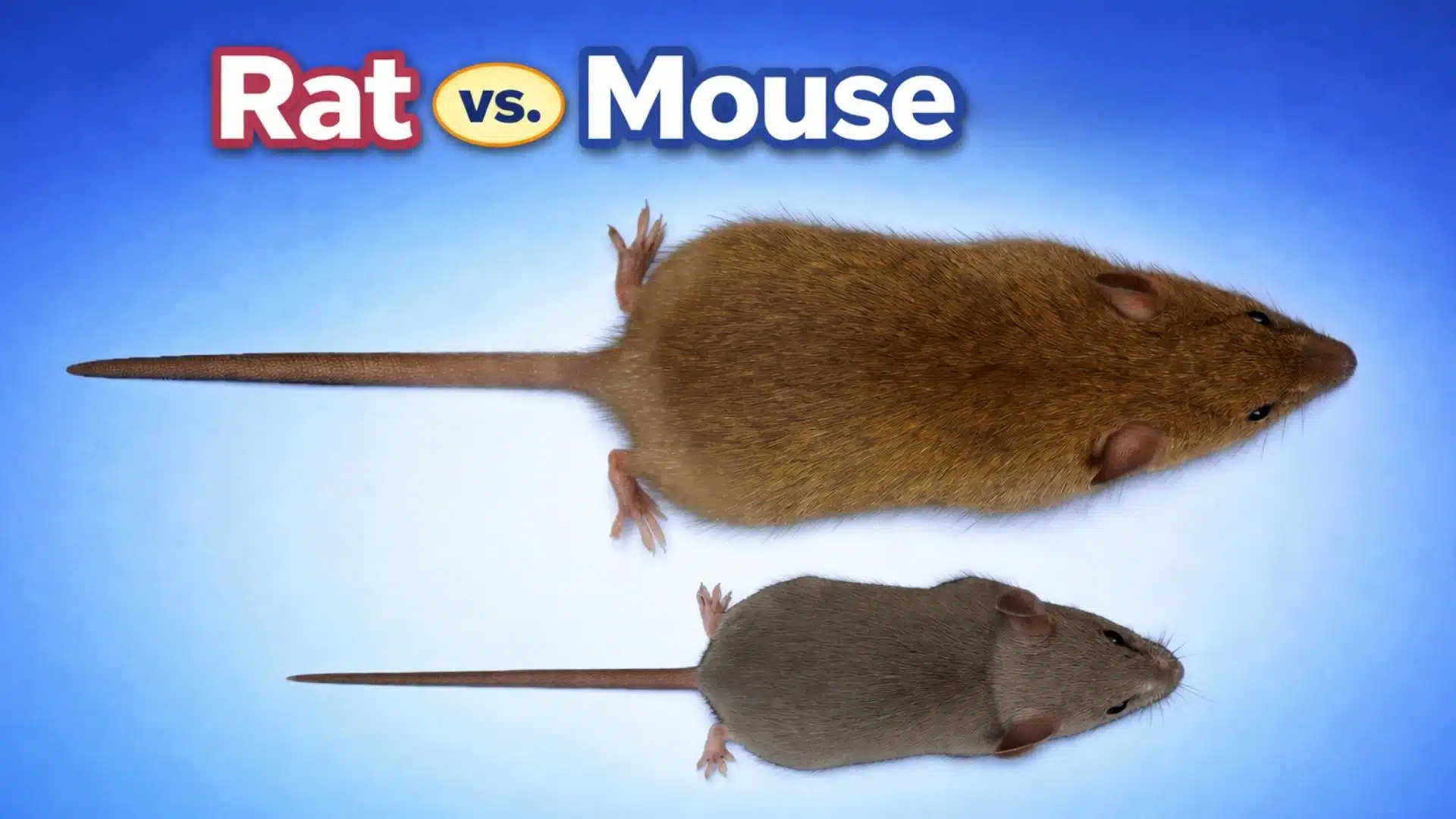
Identifying if you have a rat or mouse infestation involves examining their size, droppings, tails, ears, faces, behavior, nesting habits, and potential damage they cause.
1. Size
Size is a key difference between rats and mice.
Adult rats measure 9-11 inches in body length (16-18 inches including the tail), while mice are smaller at 3-4 inches (rarely exceeding 7-8 inches total).
Rats are heavier and denser, so they require larger traps, whereas mice are lighter and more fragile.
Baby rats may resemble adult mice, but that comparison is covered in detail in the dedicated section below.
Recognizing these differences aids in the effective identification and management of each species.
2. Droppings
Droppings are one of the most reliable ways to distinguish rats from mice, since you often find them before you see the rodent itself.
Rat droppings are about ¾ inch long, blunt-ended, and dark brown or black, resembling black raisins or capsules.
Norway rat droppings have blunt ends, while roof rat droppings are slightly smaller with pointed ends and a faint curve, a distinction that also tells you which rat species you are dealing with.
Mouse droppings are about ¼ inch long, pointed at both ends, and resemble tiny grains of rice.
Fresh droppings are soft and dark; older ones become hard and gray. Large numbers of small droppings scattered widely indicate mice, while fewer large droppings concentrated near feeding areas suggest rats.
A client once brought in a bag of droppings they had collected from their garage, convinced they had a mouse problem.
The pellets were ¾ inch long with blunt ends, which immediately told me these came from rats. That misidentification had already cost them weeks of using undersized traps with no results.
3. Shape and Length
Tails distinguish rats from mice; rat tails are thick, scaly, and rough, often shorter than their body length and matching their heavier build.
Mouse tails are thin, flexible, hairy, and longer than their bodies, providing a whip-like appearance that helps with balance.
The differences are apparent: rat tails look strong and sturdy, while mouse tails appear fine and wiry.
Examining the tail structure can aid in quick identification in low light or with brief observations.
4. Ears
Ears are key to distinguishing rats from mice.
Mice have large, rounded ears that sit high on their heads, while rats have smaller ears that are proportionate to their bodies.
Roof rats have slightly larger ears than Norway rats, but both are still smaller than mice’s ears.
This difference is noticeable in both adult and baby animals, making it a reliable identification method.
5. Nose and Head Shape
Rats differ from mice in facial features; mice have pointed noses and rounded heads, giving them a sleek look.
In contrast, rats have blunt, square noses and larger, box-like heads, giving them a heavier, more intimidating look.
A rat’s nose is wide and flat, while a mouse’s is pointed, giving mice a dainty look compared to the rugged appearance of rats.
Even young rats exhibit a blunter nose than adult mice.
Recognizing these differences can help quickly identify movement in dark or cluttered spaces.
6. Behavior and Movement
Behavior differences between rats and mice are clear.
Mice are curious and move quickly through new areas, making them easier to trap. In contrast, rats are cautious, avoid unfamiliar objects, and move deliberately along established paths.
Their neophobia makes them harder to catch. Overall, mice are opportunistic, while rats are methodical.
I advised a family dealing with confirmed rat activity in their attic to place snap traps along the baseboards. The traps sat untouched for five days before a single rat engaged with one.
When another client had mice in their kitchen, traps caught activity within the first night.
That behavioral gap changes everything about how long removal takes. Understanding these behaviors helps with effective trap placement and infestation prediction.
7. Nesting and Entry Points
Rats and mice have different nesting habits. Mice build small nests from soft materials near food sources and can enter through openings as small as a dime.
Rats need slightly larger gaps, roughly the size of a quarter, to squeeze through.
In contrast, rats create larger nests; Norway rats prefer basements, while roof rats nest in attics.
Identifying the nest’s location is key. High nests indicate roof rats, ground-level nests suggest Norway rats, and small, hidden nests suggest mice.
8. Diet Differences
Diet is a useful clue when other signs are ambiguous. Mice favor grains, seeds, fruits, and carbohydrates. They graze frequently throughout the day, eating small amounts at many locations rather than large meals in one spot.
Rats are scavengers with a preference for protein and high-fat foods; meats, pet food, and garbage are common targets.
They also consume much more water than mice, needing up to 60 ml per day compared to just 3 ml for mice. Finding water damage or drips near suspected rat activity is consistent with this need.
9. Sounds at Night
Sound is one of the most practical identification tools, especially when the rodent stays hidden.
Mice produce light, high-pitched scratching and squeaking, often inside walls or ceilings. Their movement sounds rapid and scattered.
Rats are louder. Their footsteps are heavier, and you may hear distinct thumping or gnawing sounds, particularly in attics (roof rats) or below floorboards (Norway rats). Rat gnawing is deeper and more sustained than the quick, light chewing mice produce.
Suppose the noise is faint and fast; suspect mice. If it sounds heavy enough to be mistaken for a larger animal, rats are the more likely cause.
10. Other Signs: Grease Marks and Urine Odor
Two signs that many homeowners overlook are rub marks and urine odor. Rats have naturally greasy fur, and as they travel repeatedly along the same routes, walls, baseboards, pipes, they leave behind dark, oily smear marks called rub marks.
These are a strong indicator of rat activity, specifically, since mice leave much fainter marks, if any.
Both rodents leave urine trails, but rat urine produces a stronger ammonia-like odor, particularly noticeable in enclosed spaces such as cupboards, under sinks, or in wall cavities.
Mouse urine has a musky but milder smell. If the odor is sharp enough to notice without pressing close to a surface, rats are more likely the cause.
Baby Rat vs Mouse: How to Tell Them Apart?
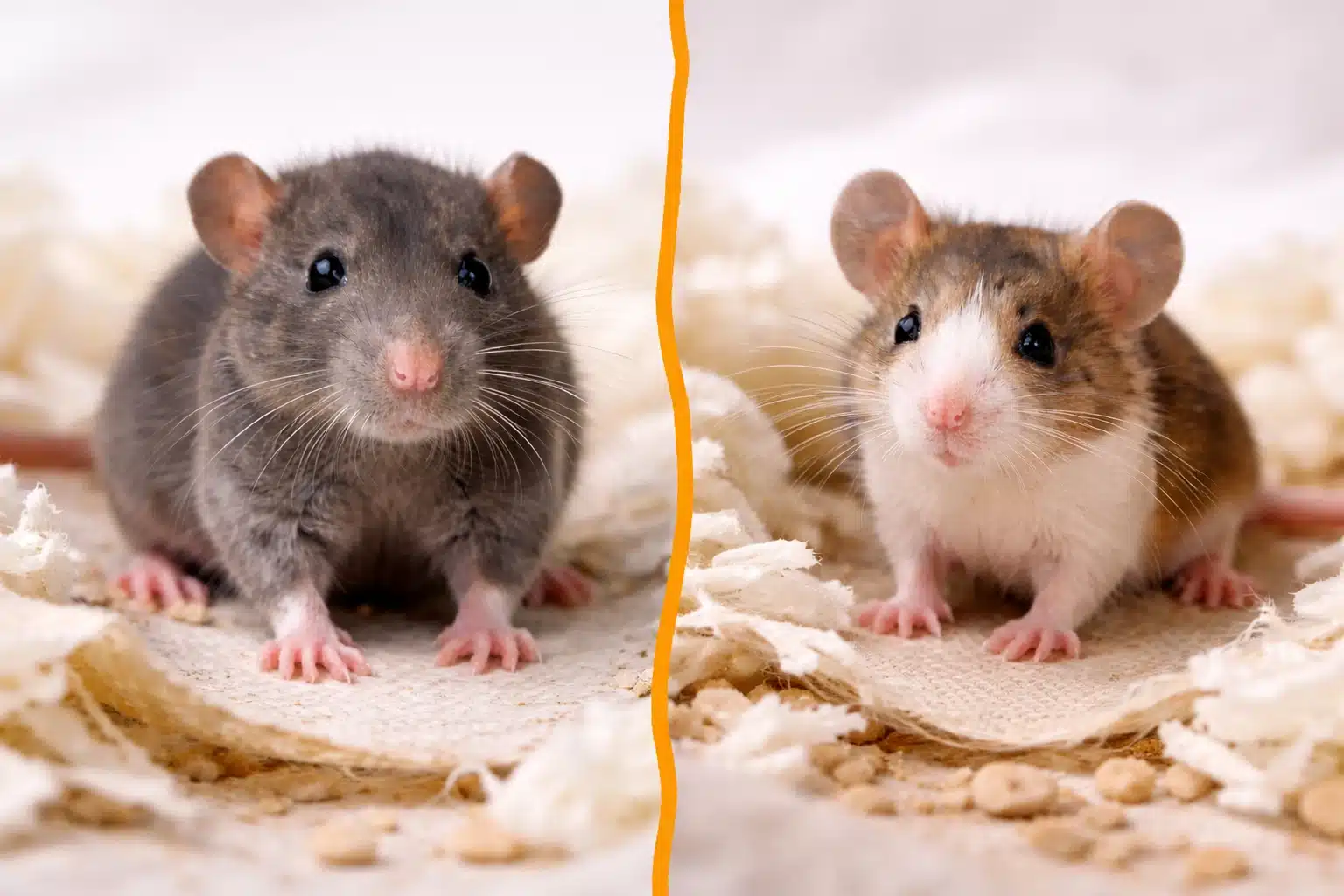
Baby rats and adult mice can be confused, but body proportions can distinguish them.
Baby rats have large heads, short, thick tails, and oversized paws, giving them a chunky look. In contrast, mice have slender bodies, long, thin tails, and small faces.
Baby mice are tiny, while baby rats are notably larger. Behavior also aids in identification: baby rats move slowly and stay close to nests, while mice are quick and scatter unpredictably.
This kind of mix-up between similar-looking animals is more common than most people think.
It mirrors how many people confuse terms in our bunny and rabbit comparison, where slight differences in language and appearance cause real confusion.
Which is Worse: Rat or Mouse?
People often ask which rodent is the bigger problem. The answer depends on what you are dealing with.
Rats cause more structural damage through chewing; wiring, insulation, and foundational materials are all at risk, and they are harder to eliminate because of their cautious behavior.
Mice reproduce faster, with females producing 5–10 litters per year and reaching sexual maturity at just 6 weeks, meaning an infestation can grow large very quickly. Rats reach maturity at around 12 weeks and produce 4–6 litters per year.
According to the Centers for Disease Control and Prevention, rodents are linked to more than 35 diseases that can affect humans.
Rats are more commonly associated with Leptospirosis and Rat-Bite Fever, while mice are primary carriers of Hantavirus and Lymphocytic Choriomeningitis.
The transmission pathways differ too: some diseases spread through direct contact with droppings or urine, while others pass through fleas and ticks from infected rodents that have fed on the host.
In my clinical practice, I have treated dogs and cats exposed to rodent-contaminated environments for years.
The pattern is consistent: rat infestations tend to cause more severe secondary health issues in pets, but mouse infestations spread faster and contaminate food sources more broadly.
Both demand immediate action, and the first step is always correct identification.
Rodent Comparison: Norway Rat vs Roof Rat vs Mouse
This table highlights key visual and behavioral differences between the two most common rat species and the house mouse, to help you identify which rodent you are most likely dealing with.
| Feature | Field Rat (Norway Rat) | Roof Rat | Mouse |
|---|---|---|---|
| Typical Size | Larger body, stocky (body 7–10 in, total 16–20 in) | Medium body (6–8 in) with tail longer than body | Much smaller (3–4 in body) |
| Body Shape | Robust, bulky build | Slender, agile build | Small, light build |
| Tail | Thick, shorter than body and head combined | Long, often longer than the body | Thin, about the same length as the body |
| Color | Brownish or grey | Dark brown/black or grey | Light brown/grey |
| Preferred Nesting | Ground-level burrows, near foundations | Raised spaces (attics, rafters, trees) | Hidden spots near food, inside walls |
| Climbing Ability | Can climb but is less adept than roof rats | Excellent climbers | Good climbers but smaller reach |
| Damage Patterns | Chews structural materials and wiring | Similar to field rats but higher in structure | Gnaws packaging, insulation, and objects |
What to Do After You Identify the Rodent?
Correct identification changes the entire approach to removal. Here are practical next steps based on which rodent you confirmed:
If you have mice: Set snap traps near walls and food sources. Seal gaps with steel wool and caulk. Remove open food sources, such as pet bowls, to reduce mouse attraction.
If you have rats: Place larger rat traps along travel paths for 2-3 days before setting. Seal gaps with metal mesh, as rats can chew through plastic and wood.
According to the U.S. Environmental Protection Agency, the most effective rodent control combines three steps: sealing entry points, removing food and water sources, and trapping. Poison alone is not recommended as a first step, especially in homes with children or pets.
Conclusion
I’ve shown you the apparent differences between rat vs mouse, from size and droppings to tails, ears, and behavior.
Each feature provides clues to help you identify which rodent is on your property.
Knowing how to tell a rat vs mouse saves time, money, and frustration. It helps you choose the right traps, baits, and prevention strategies.
If you’re dealing with droppings, strange noises, or visible rodents, these identification methods work effectively in real-world situations.
Take action now by inspecting your property for signs of either rodent. Look for droppings, gnaw marks, and greasy trails along walls.
Once you confirm which rodent you have, you can move forward with targeted removal and prevention.
Have you dealt with rats or mice before? Share your experience in the comments and let others know what worked for you.
Frequently Asked Questions
Can a Baby Rat Be Mistaken for a Mouse?
Yes, baby rats and adult mice look similar in size, but baby rats have larger heads, thicker bodies, and shorter tails. Mice maintain slender proportions even as adults.
Rat vs Mouse: Who Would Win in a Fight?
Rats would win due to their size, strength, and aggressive nature. Mice are smaller and less confrontational, so they are unlikely to challenge a rat.
Is It Better to Have a Mouse or a Rat in Your House?
Neither mice nor rats are “better” to have in your house; both are pests that cause damage, spread disease, and create fire hazards by chewing wires.