
Your dog won’t stop barking. The neighbors are annoyed, your sleep is wrecked, and walks feel stressful instead of relaxing.
It gets frustrating fast, especially when you have tried the usual advice like “just ignore it,” and nothing really changes.
As a certified professional dog trainer with years of hands-on experience working with dogs from eager puppies to hard-case rescues, I can tell you the most common reason training fails isn’t the method; it’s that the method doesn’t match the cause.
Barking is not random. There is always a reason behind it, and until you figure that out, no technique will stick.
In this guide on how to stop dog barking, you will learn what actually triggers the behavior and how to fix it using clear, tested training methods. No fluff, no unrealistic promises.
One thing to keep in mind from the start: consistency matters more than any single technique. Stick with the process, and you will see results.
Quick Reference: Match the Fix to the Bark
Not sure where to start? Use this as your entry point before reading the full guide.
- Barks for attention → Ignore and Reward Method (see below)
- Barks at doorbells/strangers → Desensitization + Incompatible Behavior Training
- Barks all night → Bedtime Routine + White Noise (see Night Barking section)
- Barks when left alone → Separation Anxiety Protocol
- Barks out of boredom → Energy Redirection + Enrichment
If barking started suddenly in a dog over 8 years old, rule out a medical cause first. Hearing loss and canine cognitive dysfunction syndrome are both known to increase vocalization in older dogs, and no training method will resolve a medical issue.
Why Dogs Bark in the First Place?
Dogs do not bark without a reason. Every bark is tied to a need, an emotion, or a trigger, and understanding that is the first step toward fixing it.
Barking is also a completely normal canine behavior. The goal of training is not to eliminate it entirely, but to reduce it to a manageable level.
Types of Excessive Dog Barking
- Attention-seeking barking: Dog has learned that barking gets results
- Boredom barking: Signals a lack of physical or mental stimulation
- Fear and anxiety barking: Triggered by stressful or unfamiliar situations
- Territorial and alarm barking: Triggered by people, animals, or sounds near their space
- Compulsive barking: Repetitive and seemingly unprovoked, may point to an underlying anxiety disorder
Different causes require different solutions. If you treat all barking the same way, you will keep hitting the same wall.
A note on medical causes: If your senior dog has started barking more frequently without a clear trigger, schedule a vet visit before starting any training.
Canine cognitive dysfunction syndrome and hearing loss are both documented causes of increased vocalization in older dogs. No amount of training will address what is fundamentally a health issue.
Identify the Type of Barking
Before you try to fix barking, you need to understand it. In my practice, this is the step most owners skip; they come to me after weeks of failed training attempts, and when I ask what specifically triggers the barking, they say “everything.”
That tells me they have been treating the symptom, not the cause. Most people skip this and jump straight to training, which is why nothing works long-term.
Start by observing patterns. When does your dog bark? Is it at a specific time of day, like evenings or late nights? Look at the triggers.
It could be the doorbell, strangers, other dogs, or even leaving the house. The environment matters too. A noisy street, confined space, or lack of stimulation can all play a role.
If you guess instead of observing, you will likely use the wrong method. And when the method does not match the cause, the barking stays.
Tip: Spend 3 to 5 days keeping a simple log, note the time, trigger, and how long the barking lasted. Patterns become obvious quickly, and this log becomes useful if you ever consult a professional trainer.
Basic Rules Before Training Starts
Before you start any training, get the basics right. These rules make the difference between progress and frustration.
- Never shout at your dog: It might feel natural, but your dog interprets it as you joining in, which escalates the barking rather than reducing it.
- Avoid punishment tools as your first response: They may temporarily stop the sound, but they do not address the root cause and can increase fear or stress over time, which often makes barking worse in the long run.
- Consistency across every person in the household is non-negotiable: If one family member ignores the barking and another responds, your dog will keep trying, because it sometimes works. Everyone in the home needs to follow the same rules.
- Reward timing is everything: If you reward even a few seconds too late, your dog will not connect the treat to the quiet behavior you want. Mark the silence the instant it happens.
- Keep training sessions short: The ASPCA and most certified trainers recommend sessions of no longer than 5 minutes, repeated multiple times throughout the day. Short, focused repetitions build behavior faster than long, irregular sessions.
Proven Training Methods to Stop Dog Barking
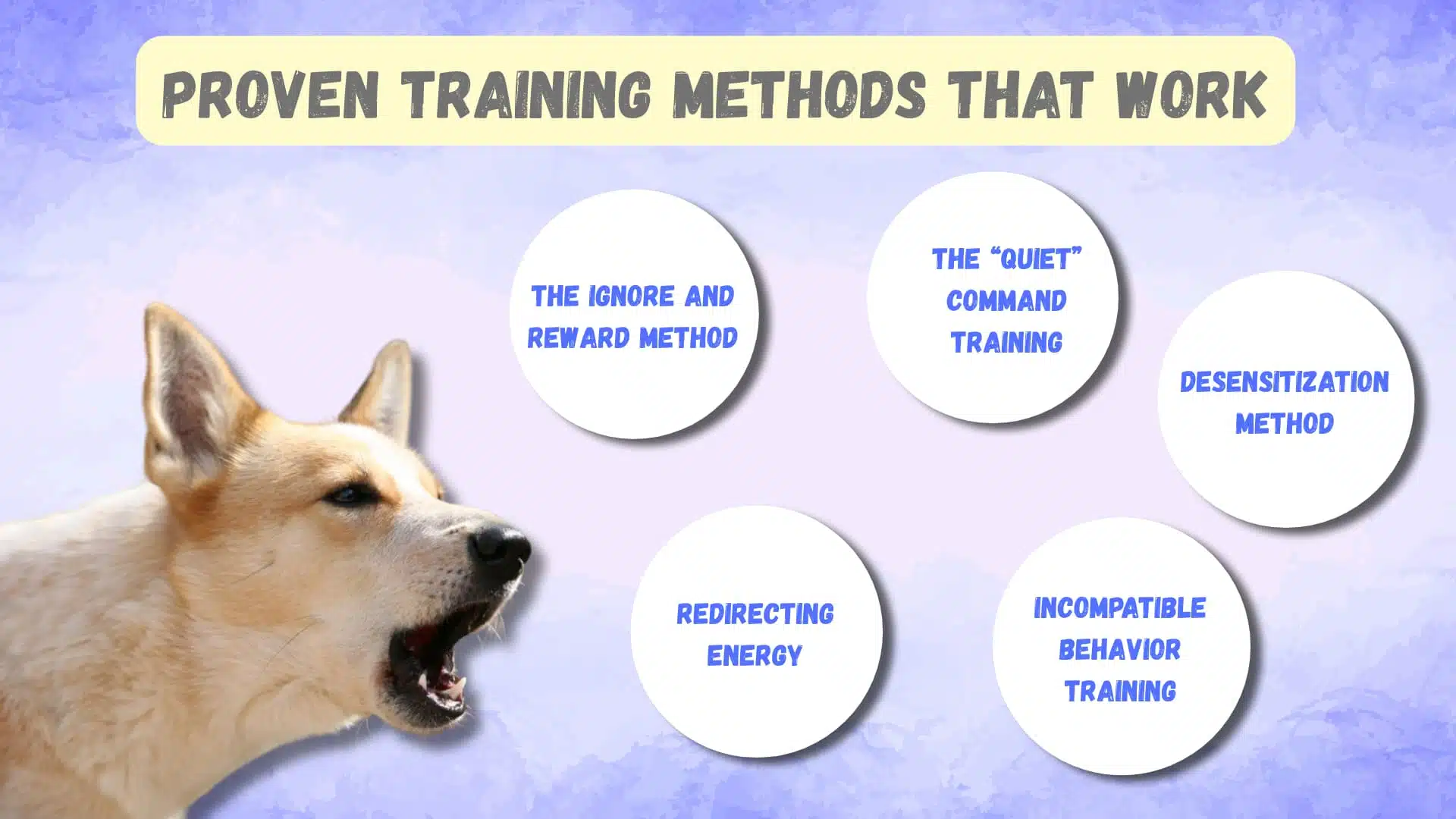
These methods target the root cause of barking, not just the noise, so you get results that actually last.
1. The Ignore and Reward Method
Best used for attention barking, when your dog barks to get your attention. Start by completely ignoring the barking. No eye contact, no talking, no touching.
The moment your dog stops, even briefly, reward that silence with a treat or attention. This teaches them that being quiet works better than barking.
Important: When you first start ignoring attention barking, it will almost certainly get louder before it gets quieter. This is called an extinction burst; your dog is essentially trying harder because what used to work has stopped working.
Most owners give in at this point, which accidentally teaches the dog that barking harder is the winning strategy. Push through it. The peak usually lasts a few days, then drops off significantly.
The biggest mistake is giving in too early, which reinforces the habit.
2. The “Quiet” Command Training
This method helps you control barking on cue. Let your dog bark once or twice, then calmly say “quiet” and wait. The second they stop, reward them immediately.
Repeat consistently so they link the word with silence. Use treats at the beginning, but slowly reduce them over time.
Clicker training variation: If your dog responds well to precision, use a clicker to mark the exact instant of silence before delivering the treat.
The clicker captures the precise moment far more accurately than a verbal reward, which can be 1 to 2 seconds delayed. That gap matters in training.
The goal is for your dog to respond to the command without needing a reward every time.
3. Desensitization Method
This works well for dogs that bark at specific triggers like doorbells or strangers. Start by exposing your dog to the trigger at a low intensity, something that does not cause a full reaction.
Reward calm behavior. Gradually increase the exposure as your dog stays relaxed.
A practical version of this for doorbell barking: record the doorbell sound and play it back at low volume during a calm training session. Reward silence. Gradually increase the volume over multiple sessions before ever introducing the real doorbell again.
If you rush this process, your dog will react and undo progress. Slow and controlled exposure is what makes this method effective.
4. Incompatible Behavior Training
This method is underused but highly effective, and it is a staple in my training sessions for doorbell and visitor barking.
The idea is simple: teach your dog a behavior that makes barking physically impossible at the same time.
The most reliable version is the “go to your mat” command. Toss a treat onto a designated mat and ask your dog to go there.
Once they reliably go to the mat on cue, practice opening the door while they stay on it. If they get up, close the door immediately and reset.
Gradually add the doorbell to the scenario. A dog lying calmly on their mat cannot simultaneously be barking at your guests.
5. Redirecting Energy
If your dog barks out of boredom or excess energy, redirection is key. Give them toys, puzzle feeders, or structured play sessions to keep their minds engaged.
Physical exercise helps, but mental stimulation often works better for reducing barking.
This approach is most effective for high-energy dogs who lack enough to do during the day, leading them to bark out of frustration or restlessness.
Environment management tip: For dogs that bark at movement or people through the window, apply frosted privacy film to the lower panels of your windows.
This removes the visual trigger without any training, and it is one of the fastest wins I recommend to clients dealing with alert barking inside the home.
Additional tool worth considering: A calming pheromone diffuser, such as an Adaptil plug-in, can help reduce baseline anxiety in dogs prone to reactivity-driven barking.
It will not replace training, but it can lower the arousal threshold enough to make training sessions more productive, particularly during the early stages.
Fixing Specific Barking Problems
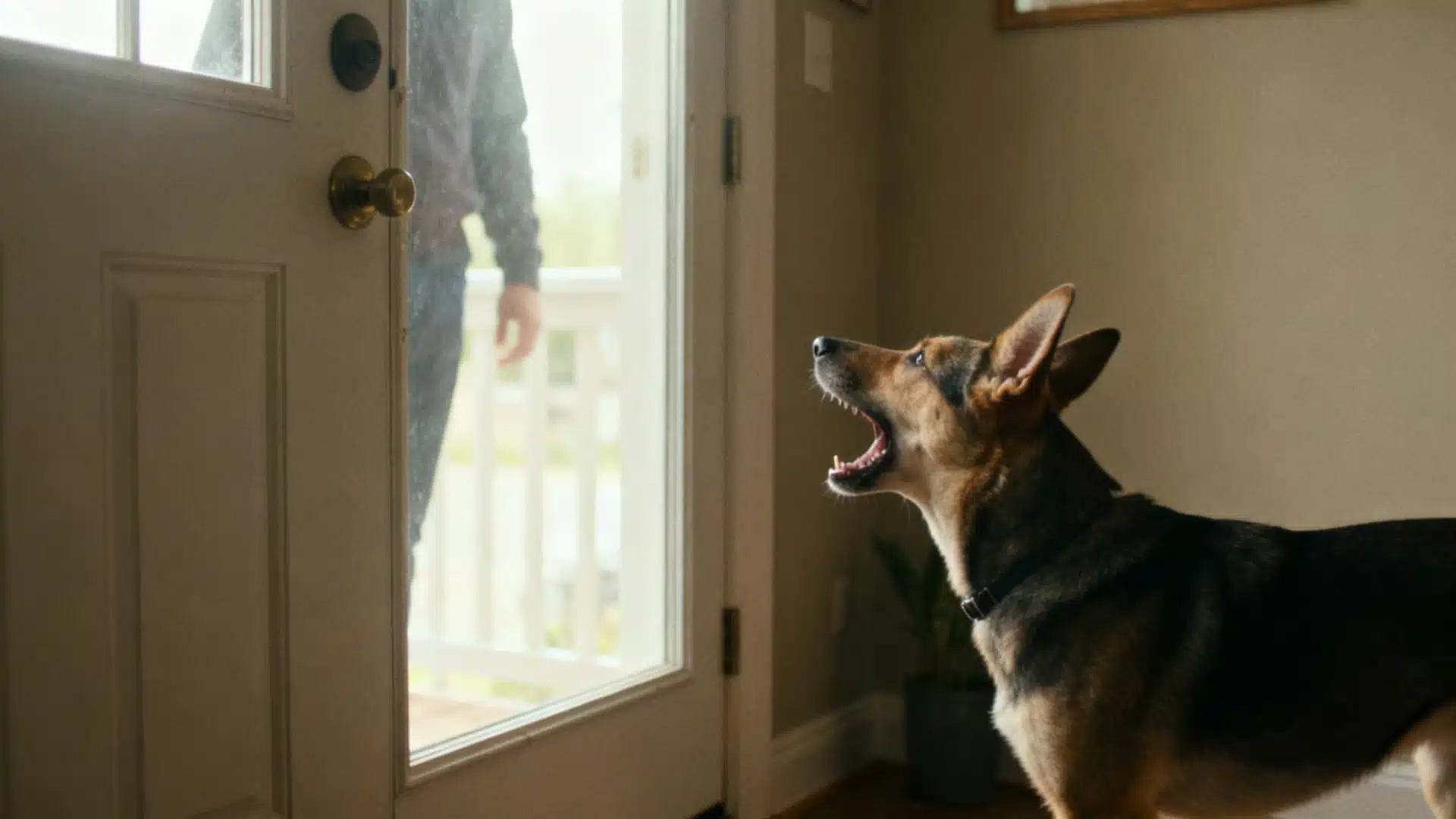
These are common real-life situations where barking gets out of control, and each one needs a slightly different approach.
1. Dog Barks at Night
Night barking usually stems from anxiety, boredom, or a reaction to outside noises. Start by making sure your dog gets enough activity during the day so they are not restless at night.
Create a calm sleeping setup with minimal disturbances. If noise is the trigger for dog coughing or barking at night, naturally, use background sounds to mask it.
For anxious dogs, a consistent bedtime routine helps them settle and feel secure.
A white noise machine or a fan placed near their sleeping area works well to mask street sounds. This is one of the first things I suggest for dogs in apartments or on busy roads.
If the barking is anxiety-driven rather than noise-reactive, a consistent pre-sleep routine helps regulate their system significantly faster than training alone.
In my practice, a short 10-minute walk, a brief quiet period, and settling in the same spot each night can produce noticeable improvement within a week for most dogs. Getting the proper crate setup right also makes a meaningful difference for dogs that sleep in a crate, since a crate that feels too large or too exposed can increase nighttime restlessness rather than reduce it.
2. Dog Barks at Strangers
This often comes from fear or territorial behavior. Start with basic socialization by exposing your dog to people gradually, not all at once.
Keep a distance at first and reward calm behavior. Slowly reduce the distance as your dog gets comfortable.
Avoid forcing interaction, as that can increase stress. The goal is to teach your dog that strangers are not a threat.
Note: Some breeds, including Beagles, Miniature Schnauzers, and many terriers are genetically predisposed to higher alert and territorial barking. Understanding breed traits that affect barking helps set realistic expectations before you start training.This doesn’t mean training won’t work, but it does mean your baseline expectation should be “reduce significantly” rather than “eliminate.” Setting a realistic goal makes a real difference to owner frustration during the process.
3. Dog Barks When Left Alone
This is usually linked to separation anxiety. Signs include barking, pacing, or destructive behavior when you leave.
One of the most common cases I work with is newly adopted rescue dogs; they can show extreme separation distress in the first weeks, even if they seemed calm at the shelter.
The shelter environment is actually very different from the quiet of a home, which is why the barking surprises new owners.
Start with short departures and return before your dog becomes stressed. Gradually increase the time away.
Avoid making a big deal out of leaving or returning. Research from applied animal behaviorists confirms that separation anxiety requires a gradual, systematic approach; rapid departures without a desensitization protocol consistently fail.
Using a smartphone camera or a pet monitor app to observe your dog’s behavior while you’re away helps you understand whether the barking starts immediately (true separation anxiety) or after a delay (boredom or territorial alerting), which changes the approach entirely.
Multi-dog households: If one dog’s barking is triggering the others, address the “lead barker” first. Reactive barking in packs is contagious; the other dogs often follow a cue rather than react independently. Identifying and working with the trigger dog usually quiets the whole group.
Tools That Can Help Stop Dog Barking
These practical tools support different barking triggers, helping manage behavior more effectively while complementing consistent training efforts and creating a calmer, more controlled environment for dogs.
| Tool | Best For | Notes |
|---|---|---|
| White noise machine | Night barking, alarm barking | Masks outdoor sounds that trigger reactive barking |
| Puzzle feeders | Boredom barking | Mental stimulation reduces daytime restlessness |
| Frosted window film | Alert and territorial barking | Removes visual triggers without any training required |
| Pheromone diffuser (e.g., Adaptil) | Anxiety-driven barking | Lowers baseline arousal; supports training, does not replace it |
| Pet monitor app or camera | Separation anxiety | Helps identify whether barking is immediate or delayed, guiding the right method |
| Clicker | Quiet command training | Marks the exact moment of silence more precisely than a verbal reward |
Common Mistakes That Make Dog Barking Worse
A lot of barking problems get worse because of the wrong approach, not the dog itself.
- Do not use punishment collars without professional guidance: Shock or citronella collars may suppress barking temporarily, but they do not address the underlying cause. For anxiety-driven barking in particular, they can increase fear and stress, which often amplifies the behavior once the collar is removed.
- Do not yell or react emotionally: Your dog may interpret raised voices as you joining in, or feel more anxious as a result, which generates more noise rather than less. Even negative attention is still attention to a dog seeking a response.
- Do not apply inconsistent rules: If barking is ignored one day and gets a reaction the next, your dog learns that persistence pays off. Clear and consistent responses from every person in the household are what actually produce lasting change.
- Do not assume the method is wrong before the timeline is up: Many owners switch techniques after a few days and never give any single approach enough time to work. Behavior change takes repetition. Switching too early resets progress and leaves the dog with no clear pattern to follow.
How Long Does It Take to Stop Barking?
There is no fixed timeline, and anyone promising quick results is overselling it. 2 to 4 weeks of consistent daily training.
Dogs dealing with moderate to high reactivity, fear-based barking, or separation anxiety can take 2 to 3 months, and that timeline assumes daily structured sessions, not occasional attempts.
Factors like age, breed, past habits, and the type of barking all affect progress. A dog barking out of boredom is usually easier to train than one barking out of anxiety or fear.
Patience is what makes the difference. If you switch methods too quickly or expect instant results, you will reset progress.
Stick to one approach, stay consistent, and give your dog time to learn what you expect.
When to Consider Professional Help?
Sometimes, barking goes beyond basic training and needs expert support. If your dog shows extreme anxiety, like constant barking, pacing, or panic, even in calm situations, it is a sign that deeper issues are involved.
Aggression linked to barking, such as lunging or snapping, should also not be handled on your own, as it can escalate quickly.
When choosing a professional, the credential matters. A Certified Professional Dog Trainer (CPDT-KA) is best for obedience and behavior training.
A Certified Applied Animal Behaviorist (CAAB) or a board-certified veterinary behaviorist (DACVB) handles deeper emotional and psychological issues, including severe separation anxiety or fear-based aggression, and can work alongside a vet to assess whether medication is an appropriate short-term bridge to allow behavior therapy to work.
If you are unsure which type of professional you need, start with a CPDT-KA assessment; they will refer you up the ladder if the case warrants it.
Conclusion
Stopping excessive dog barking is not about finding a magic command. It is about accurately identifying the cause, matching the right method to it, and staying consistent long enough for the new behavior to replace the old one.
That process takes time, but it works. Whether your dog barks for attention, out of fear, or from boredom, the fix is always rooted in understanding what is driving it.
Stay patient, stick to one approach at a time, and focus on small wins.
A dog that was barking for 40 minutes a day and now barks for 10 is making real progress, even if it does not feel like enough yet. Over time, those small changes add up to lasting results.
If you are dealing with a specific barking issue or something not covered here, drop your comments below. Your situation might help others facing the same problem.
Frequently Asked Questions
Does Ignoring a Barking Dog Work?
It works specifically for attention-seeking barking, where the dog has learned that barking produces a response. Complete and consistent ignoring, combined with rewarding silence, is highly effective for this type. It does not work for fear-based, territorial, or anxiety-driven barking, where the cause is not attention-seeking at all.
Can a Dog Be Trained Not to Bark at All?
No, and that should not be the goal. Barking is a normal, healthy form of communication. The realistic goal is to reduce excessive or uncontrolled barking to a manageable level, while still allowing a dog to communicate naturally. Dogs that are trained toward complete silence often show increased stress or redirect into other problem behaviors