A quiet kitchen moment can suddenly turn strange when a cat starts acting excited around something unexpected.
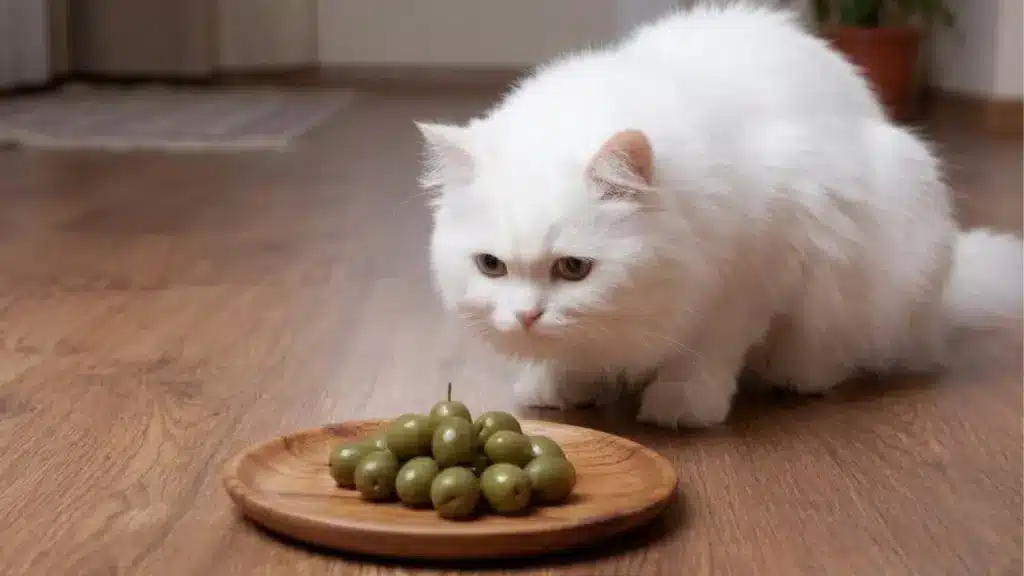
Many cat owners have seen this happen with olives. The moment an olive appears, a curious cat may sniff, roll, rub, or paw at it as if it had just discovered a favorite toy.
That reaction often makes people stop and wonder, do cats like olives, or is something else happening? And the answer can be surprising.
Cats experience the world through scent, and certain smells can trigger playful or curious behavior.
Watching a cat react this way can be funny, confusing, and a little fascinating at the same time.
Understanding why cats like olives helps explain this quirky behavior and reveals how powerful a cat’s sense of smell really is in everyday life.
Are Olives Safe for Cats Nutritionally?
The fat in olives is not harmful in tiny amounts, but it can upset the stomach if a cat eats too many. For this reason, olives should only be seen as an occasional curiosity rather than a snack.
A cat may enjoy the smell or taste, but regular cat food already provides the nutrients a cat needs.
Olives contain a few nutrients that may catch the attention of curious cat owners, but they are not a meaningful food source for cats.
A typical olive includes small amounts of healthy fats, vitamin E, and antioxidants.
These nutrients support general health in humans, yet cats do not gain much benefit from them because a feline diet relies mainly on animal protein.
Olives also contain sodium, especially when they are preserved in brine, and too much salt is not suitable for cats.
Do Cats Like Olives?
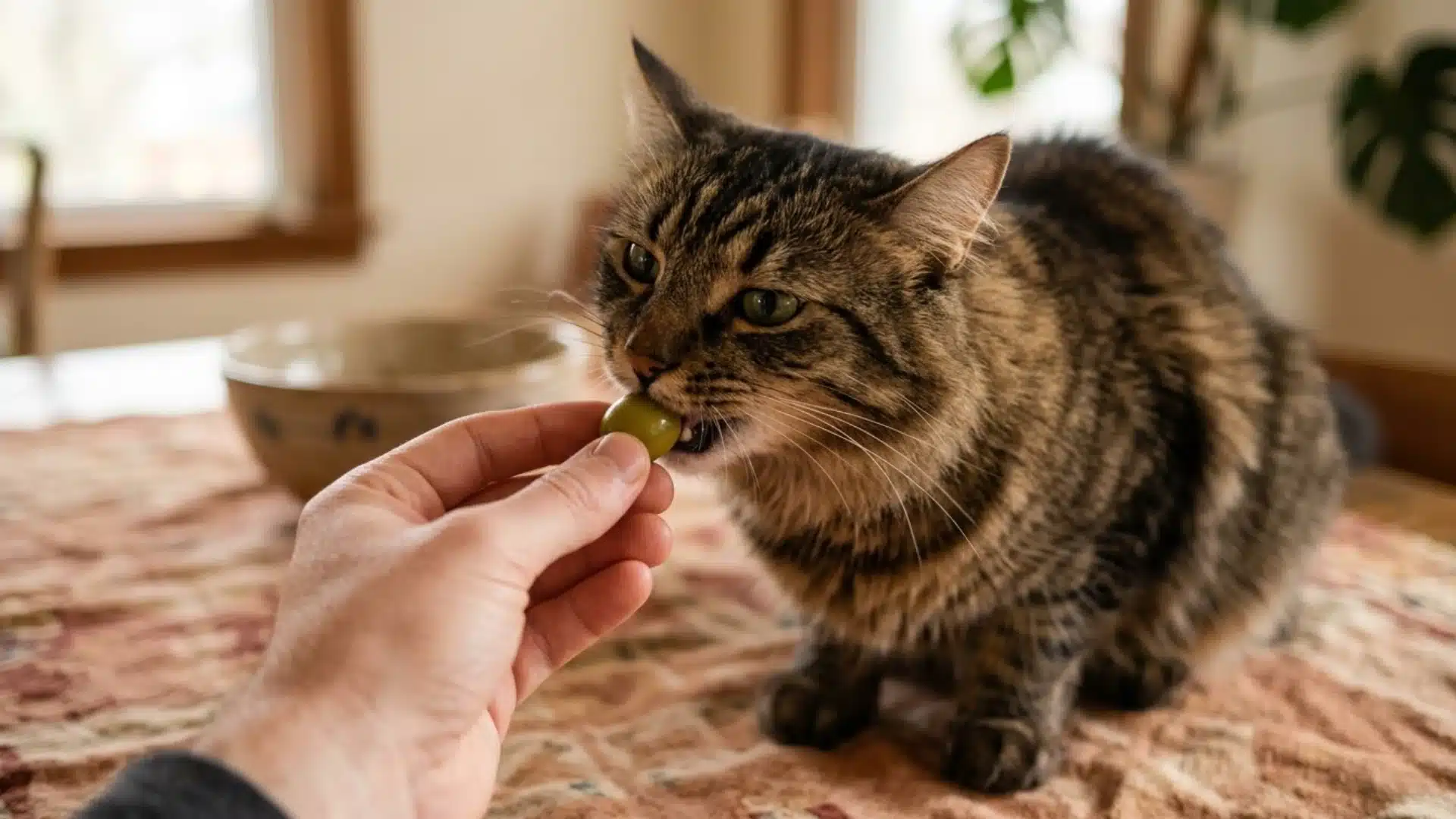
Many cats do seem to like olives, or at least they become very curious when they smell them.
This reaction happens because olives contain natural chemical compounds called isoprenoids and oleuropein, which can trigger a response in some cats that looks similar to catnip behavior.
When a cat smells olives, the scent molecules are detected not only through the nose but also through a special organ called the vomeronasal organ, located on the roof of the mouth.
This organ helps cats process scent signals related to behavior and attraction.
Cats have an extremely strong sense of smell, and different types of olives can trigger slightly different reactions.
Green olives often have a stronger scent, so cats may sniff them more actively or roll around them. Black olives usually have a milder smell, so some cats may only show light curiosity.
Kalamata olives have a rich aroma that can attract certain cats to sniff or lick them briefly.
However, reactions vary because each cat responds differently to scent.
Can Olives Replace Catnip for Cats?
Olives can attract some cats, but they cannot replace catnip.
The smell of olives contains natural compounds that may trigger playful behavior in certain cats, which is why some cats sniff, rub, or roll around when they find one.
This reaction can look similar to the excitement caused by catnip, but the effect is usually weaker and less consistent.
Catnip contains a compound called nepetalactone that specifically affects a cat’s sensory receptors and often creates a stronger response.
Olives do not contain the same compound, so the reaction is milder and does not last as long. Some cats may show curiosity toward olives, while others show no interest at all.
Because of this, olives should not be used as a replacement for catnip. Catnip remains the more reliable option for stimulating play and enrichment.
Real User Experience About Cats and Olives
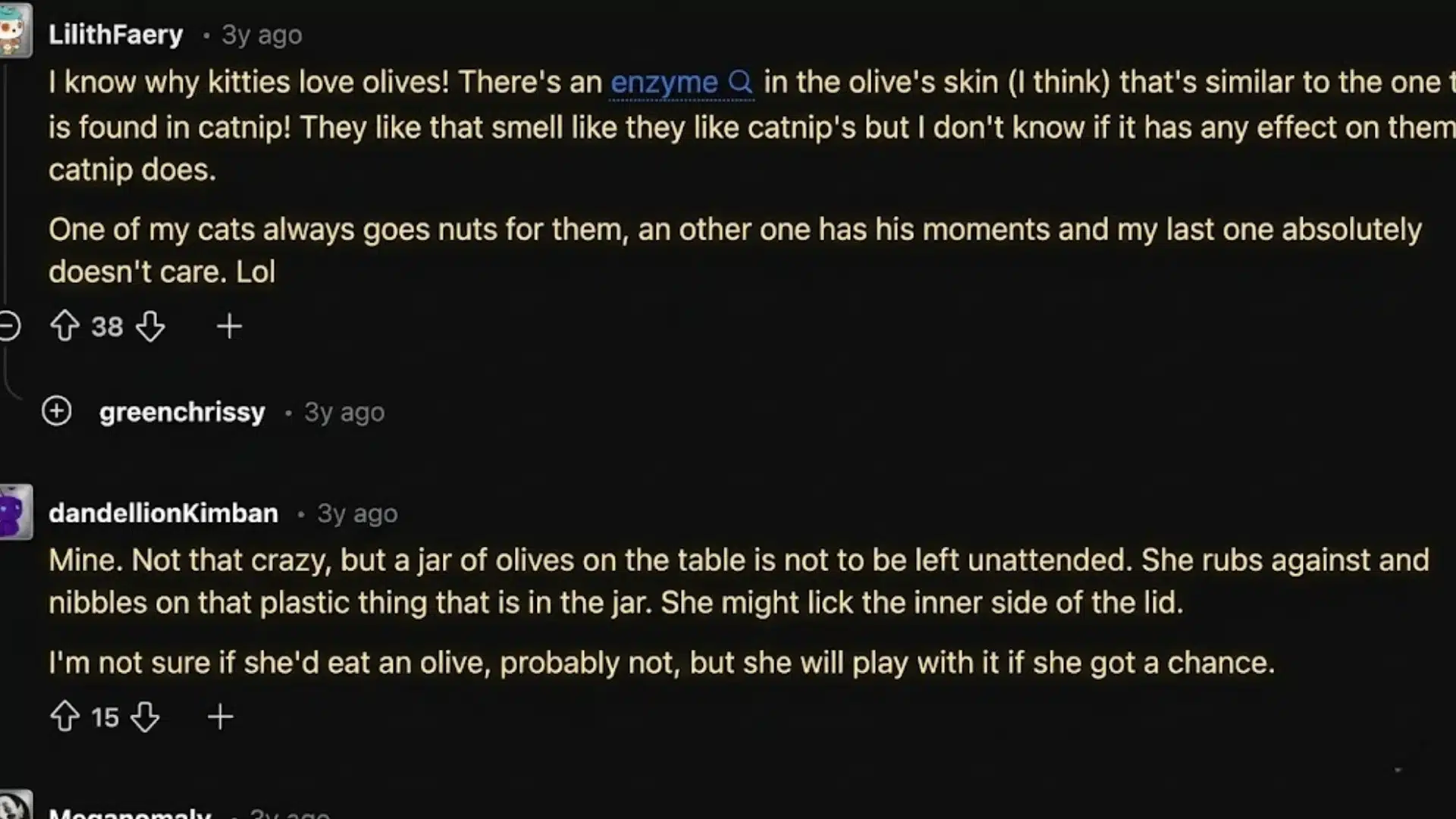
Many cat owners on Reddit report surprisingly similar experiences when olives are around.
One user shared that their cat becomes extremely excited whenever it smells green olives.
Instead of eating them, the cat rubs its head on the olive, rolls around with it, and reacts almost the same way it does with catnip.
Interestingly, the owner mentioned that their other cat shows no interest at all.
Several commenters confirmed similar behavior. Some explained that olives contain compounds similar to those found in catnip, which may trigger playful reactions in certain cats.
Others described cats running toward the sound of an olive jar opening or rubbing against anything that smells like olive juice.
However, not every cat reacts this way. Some ignore olives completely, while others simply play with them rather than eating them.
Should You Let Your Cat Play With Olives?
Letting a cat play with an olive once in a while is usually harmless, but it should not become a regular habit.
Many cats are attracted to the smell of olives and may sniff, lick, or roll around with them.
However, olives often contain salt, oils, or pits that can create problems if a cat eats too much.
A small piece of plain olive without the pit may be safe for brief interaction, but supervision is important. Instead of relying on olives, safer options exist that are made specifically for cats.
Catnip toys, dried catnip leaves, silvervine sticks, and valerian root toys can provide similar excitement without dietary concerns.
These alternatives are designed to stimulate a cat’s senses and encourage play in a safer way.
Choosing these options helps keep a cat entertained while avoiding unnecessary risks from human foods like olives.
Potential Signs a Cat is Reacting Badly to Olives
Most cats show curiosity toward olives without serious problems, but eating too many or consuming salted olives can sometimes upset a cat’s system.
- Vomiting: A cat may throw up after eating olives if the stomach cannot tolerate the oils, salt, or unfamiliar food.
- Diarrhea: Loose stools or frequent bathroom visits can appear when olives irritate a cat’s digestive system.
- Lethargy: A cat that suddenly becomes unusually tired or less active after eating olives may be experiencing digestive discomfort.
- Excessive Thirst: Salted olives contain high sodium, which may cause a cat to drink more water than usual.
- Loss of Appetite: A cat may avoid food for a short time if olives cause stomach upset or mild nausea.
What to Do if Your Cat is Obsessed with Olives?
Most veterinarians recommend giving only a very tiny amount of olive oil if a cat shows interest. Treats like olives should also stay under 10% of a cat’s daily diet.
If a cat seems obsessed with olives, the first step is to limit access and keep olives out of reach.
While the smell may attract a cat, olives are not a suitable snack and should not become part of a regular routine.
If a cat keeps trying to grab olives from the table or kitchen counter, it helps to redirect that curiosity toward safer options.
The best approach is gentle redirection and consistent boundaries. Providing proper cat treats and stimulating toys keeps the cat satisfied without relying on olives.
Conclusion
Cats and olives create a curious combination that many pet owners notice at some point.
When asking do cats like olives, the answer often depends on the individual cat.
Some cats show excitement when they smell olives because certain compounds in olives can stimulate their senses in a way that resembles catnip.
Others may ignore them completely, which is perfectly normal since every cat reacts differently to scents.
While a small taste of plain olive or olive oil is usually harmless, olives should never replace a proper cat diet or regular cat treats.
Safer alternatives remain better options for play and enrichment.
Have you ever seen a funny reaction from a cat around olives? Share the experience in the comments below.