



You toss a bright red toy across the room, expecting your cat to chase it instantly. Instead, it just sits there, staring past it like the toy barely exists.
Moments like this make many cat owners think: can cats see colors the same way we do, or is their world just a blur of grey shades?
For years, people believed cats were completely colorblind and could only see in black and white. That idea has stuck around, but science tells a different story.
Cats can see colors, though their eyes work very differently from human eyes. Certain colors stand out to them while others look dull or nearly the same.
Understanding whether cats can see colors not only clears up this long-standing myth but also reveals how they actually experience the world around them.
Can Cats See Colors?
Yes, cats can see colors, according to the National Center for Biotechnology Information, but their color range is smaller than that of humans because of differences in feline vision and retinal cone photoreceptors.
Many people believe cats are completely color blind and only see the world in black and white.
That idea is not accurate. Cats can perceive certain colors, though their vision does not encompass the full spectrum humans experience.
Because their eyes contain fewer cone cells, their color vision is more limited. Shades like blue and yellow tend to stand out more clearly to them, while colors such as red or orange may appear dull or grayish.
Instead of relying heavily on color, cats focus more on movement and brightness.
This ability helps them detect small motions quickly, which is far more useful for hunting and reacting to their surroundings.
How Cat Vision Works?
Color vision depends on special cells in the eye called rods and cones. Rods help with seeing in low light and detecting movement, while cones allow the eye to perceive different colors.
Humans have three types of cone cells, which let us see a wide spectrum of colors, including red, green, and blue.
Cats, however, have only two types of cones. Because of this difference, their eyes process a smaller range of colors.
Instead, they are known as dichromats, meaning they rely on two types of cones instead of three. This limits their color range but still allows them to see certain colors more clearly than others.
What Colors Can Cats Actually See?
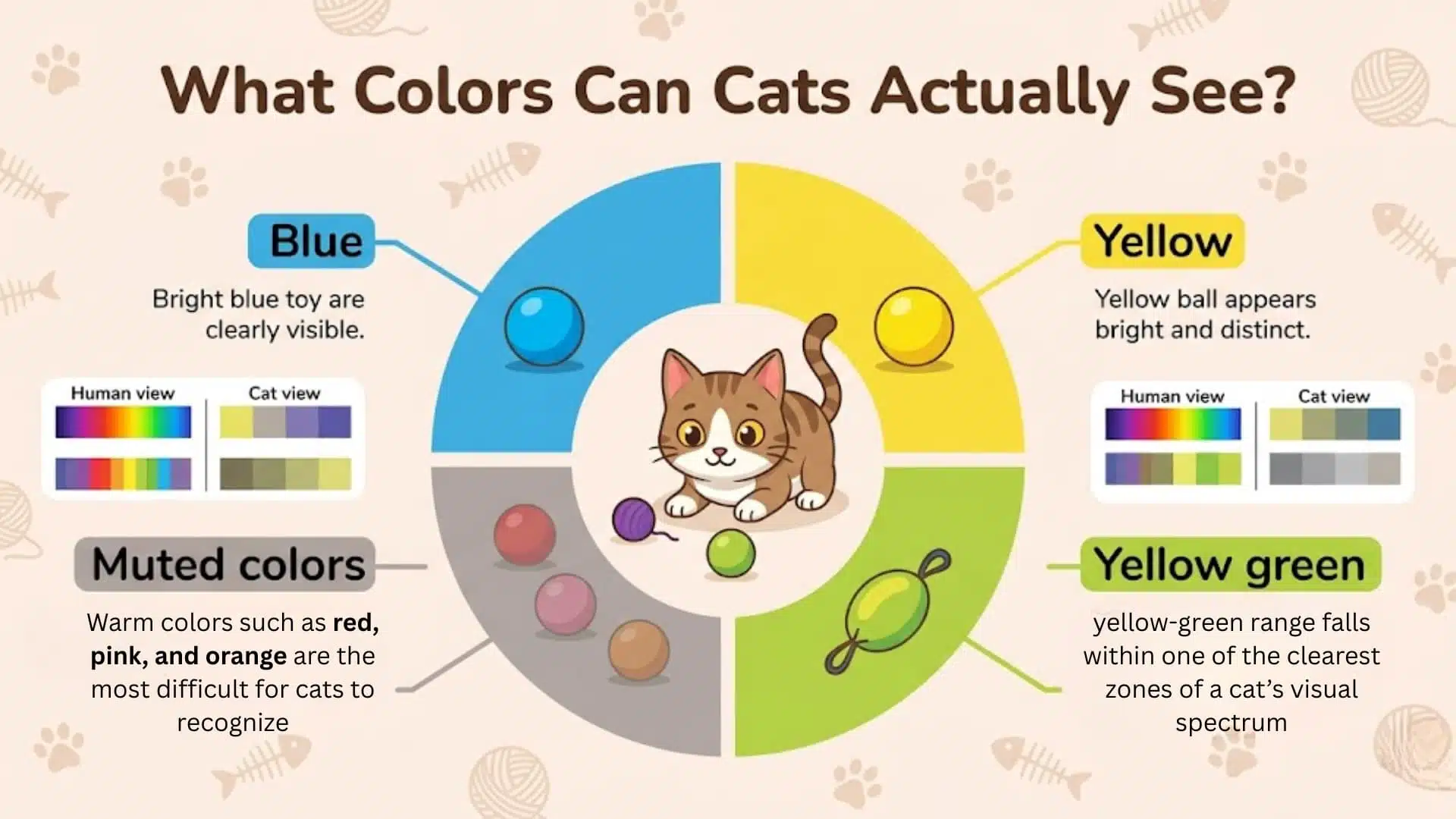
While cats do see colors, their visual range is narrower than ours. Certain shades appear clearer to them, while others look dull or nearly indistinguishable.
1. Blues
Blue is one of the colors cats can recognize most easily. Because their cone cells function differently, shades of blue tend to stand out more clearly in their vision.
Objects that appear bright blue to humans usually remain noticeable to cats as well.
This is why many cat toys use blue tones: these colors are easier for cats to detect than warmer shades.
2. Yellow
Yellow is another color that cats can recognize fairly well. In their vision, yellow tones often appear brighter and more noticeable than many warmer shades.
Objects that fall in the yellow or yellow-green range are easier for cats to distinguish from their surroundings.
This is why toys or items with yellow tones can sometimes attract a cat’s attention more quickly during play.
3. Yellow Green Range
The yellow-green range falls within one of the clearest zones of a cat’s visual spectrum.
While cats may not see the full variety of green shades humans do, this range still appears fairly visible to them.
Colors in this spectrum can stand out more clearly against darker backgrounds, making them easier for cats to notice compared to reds, pinks, or oranges.
4. Colors That May Look Muted
Warm colors such as red, pink, and orange are the most difficult for cats to recognize. Their eyes lack the cone receptors needed to accurately process these shades.
Because of this, these colors may appear faded, brownish, or even gray. A bright red object that stands out strongly to humans might not attract much attention from a cat.
Can Cats See in the Dark?
Cats are famous for their ability to move around easily at night, but they do not see in completedarkness.
What they do have is excellent low-light vision. Their eyes contain far more rod cells than human eyes.
Rods are the cells responsible for detecting light and motion, which allows cats to see clearly in dim environments where humans struggle.
Another important feature is the tapetum lucidum, a reflective layer behind the retina that bounces light back through the eye. This is the reason a cat’s eyes appear to glow in the dark.
The trade-off is that more rods mean fewer cones, which reduces color detail. Compared with humans and even dogs, cats perform far better in low-light conditions.
Cat Vision Compared to Humans and Other Animals
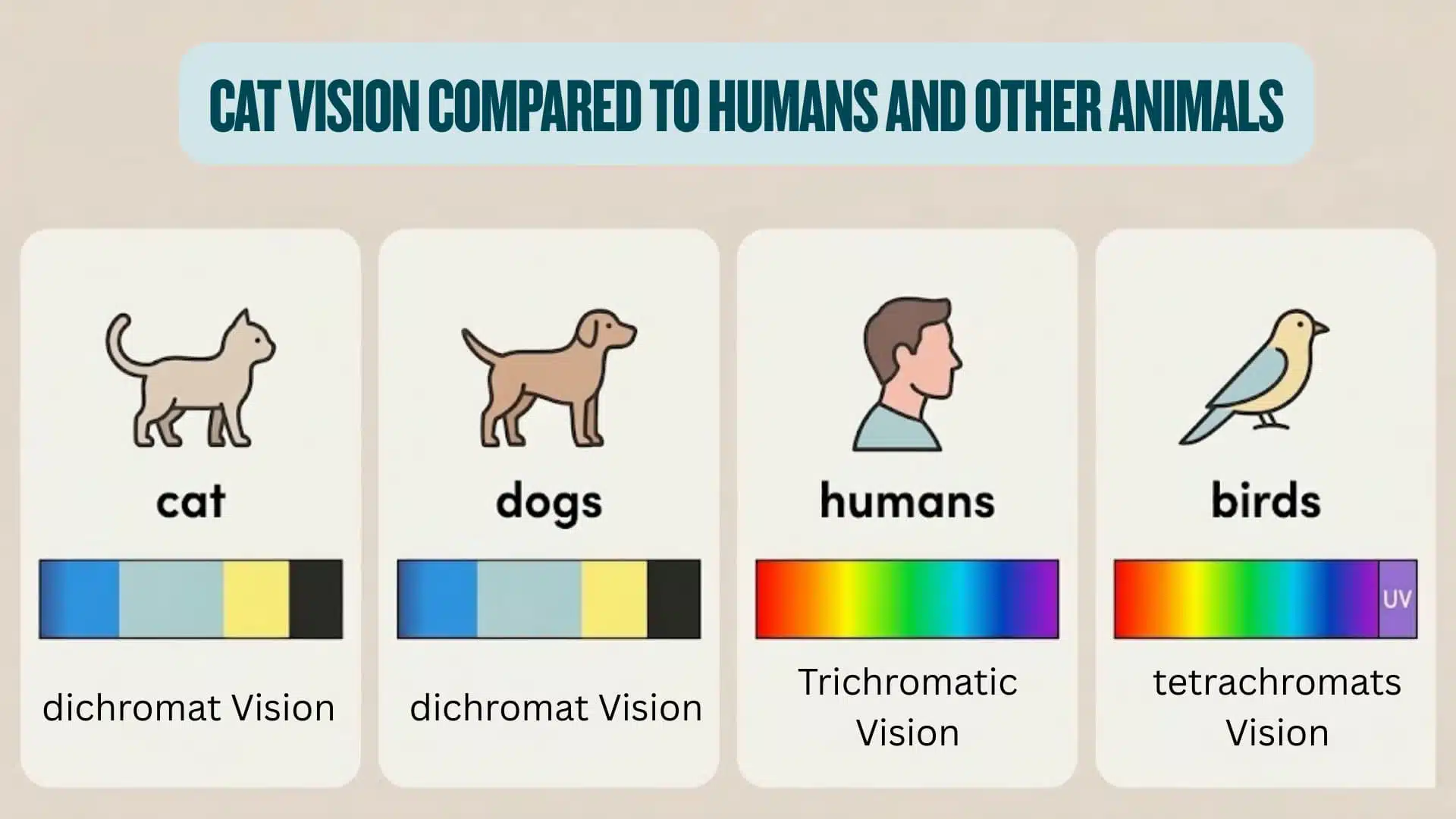
Cats do see colors, but their visual abilities fall somewhere in the middle compared with those of others. Some species see fewer colors than cats:
1. Dogs
Cats and dogs both have dichromatic vision, meaning they have two types of cone cells for detecting color.
As a result, their color perception is quite similar. Both animals mainly see shades of blue and yellow, while reds and greens are harder to distinguish.
The biggest difference is not color but function. Cats rely more on motion detection and low-light vision, which helps them hunt in dim environments.
2. Birds
Birds have far more advanced color vision than cats. Many bird species are tetrachromats, meaning they have four types of cone cells instead of two.
This allows them to see a wider spectrum of colors, including ultraviolet light that humans and cats cannot detect.
Because of this, birds experience a much richer, more detailed color world than the limited palette cats see.
3. Humans
Humans have three types of cone cells, which allow us to see a full range of colors across the visible spectrum.
Cats, with only two types of cones, see fewer color variations. While humans clearly distinguish reds, oranges, and greens, cats often see these colors as duller.
Their vision is less about color richness and more about detecting movement and brightness in their surroundings.
How Cats See the World Compared to Humans?
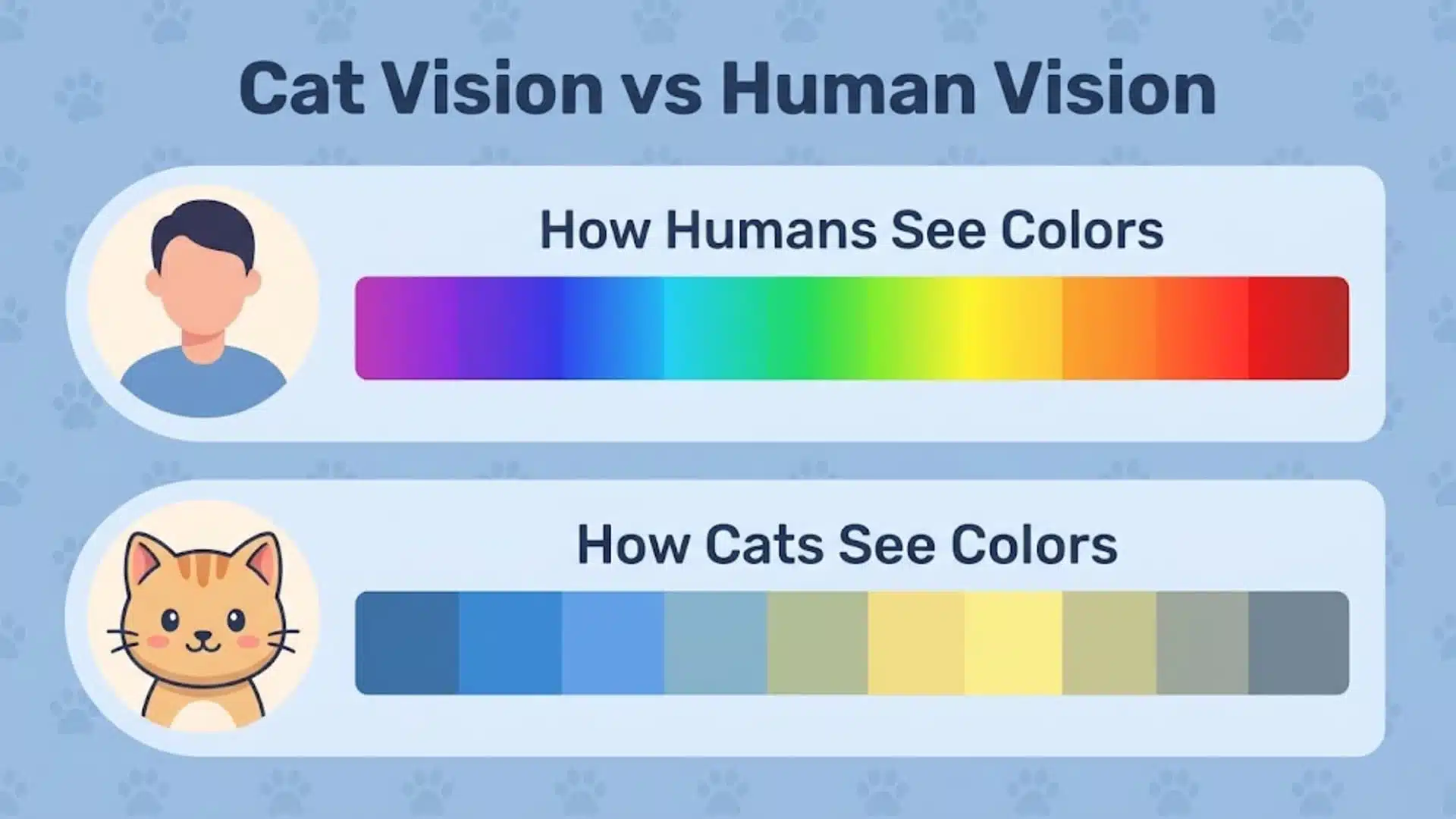
The world looks slightly different through a cat’s eyes compared with human vision. Humans see a wide spectrum of vibrant colors, including red, orange, green, and blue.
Cats, however, experience a reduced color range. Imagine a room filled with colorful toys and furniture. A human would notice strong reds, bright greens, and deep oranges across the space.
A cat would likely see the same scene with fewer distinct colors. Blues and yellowish tones would still stand out, but reds and oranges might appear dull, brownish, or gray.
This color reduction happens because cats have only two types of cone cells in their eyes, while humans have three.
As a result, cats rely more on brightness and movement than on detailed color differences.
Key takeaway: Cats have wider peripheral vision, around 200 degrees, compared to about 180 degrees in humans, helping them detect movement from the sides more easily.
Does Color Even Matter to Cats?
Color is not the main factor that grabs a cat’s attention. Cats depend far more on movement and contrast when reacting to objects around them.
A bright red toy might look exciting to you, but may appear dull or grayish to your cat, which explains why it sometimes gets ignored.
On the other hand, toys in blue or blue-green shades can be easier for cats to notice. Even then, motion often matters more than color itself.
When hunting or playing, cats rely heavily on their hearing and sense of smell, using sound and scent to locate prey before relying on sight.
For cat owners, this means choosing toys that move easily, make noise, or offer strong contrast rather than focusing only on bright colors.
Simple Ways to Test Your Cat’s Color Vision at Home
You can try a few simple observations at home to understand how your cat responds to different colors, movement, and contrast during play or daily activity.
- Different colors: Offer toys in blue, yellow, red, and green, then observe which ones your cat notices first during playtime.
- Same shape: Use toys with the same size and shape, so color becomes the main difference in your small test.
- Reaction time: Toss two toys of different colors and notice which one your cat reacts to faster.
- Same lighting: Perform the test in the same lighting conditions so brightness does not influence your cat’s response.
- Repeated tests: Try the test several times on different days to see if your cat consistently reacts to specific colors.
Conclusion
Cats do not experience the colorful world the same way humans do, but that does not mean their vision is dull or colorless.
The question of whether cats can see colors has a clear answer: yes, they can, though their range is more limited.
Their eyes are designed more for detecting movement and seeing in low light, which helps them hunt and stay alert.
Understanding how cats see can also help you choose toys and objects that better grab their attention.
Have you ever noticed your cat reacting differently to certain colors? Drop your comments below and share what you have observed with your cat.
Frequently Asked Questions
Can cats see the color purple?
Cats cannot truly see purple. It usually appears closer to blue or gray because their eyes detect mainly blue and yellow wavelengths.
Do kittens see colors the same as adult cats?
No. Kittens have weak vision at birth. Their color perception develops over several weeks and becomes similar to that of adult cats as their eyes mature.
Do different cat breeds see colors differently?
No. All cat breeds have the same eye structure, so their color vision works the same regardless of breed.